• Skip to primary navigation
  • Skip to main content
  • Skip to primary sidebar
  • Home
  • About
  • Contact
  • Privacy + Terms
  • Affiliates

The Chaos and the Clutter

  • Facebook
  • Twitter
  • Pinterest
  • Google Plus
  • RSS
  • Email
  • School at Home
  • Sensory
    • Sensory Processing Disorder
    • Awesome Sensory Play Activities
      • Sensory Bins
      • Sensory Bottles
      • Sensory Bags
  • Family Games
    • Minute to Win It Games
  • Special Needs Parenting
    • Childhood Anxiety
    • Reactive Attachment Disorder
    • Sensory Processing Disorder
  • Store
  • Course Login

Archives for 2019

Nativity Sensory Activities

By Sharla Kostelyk

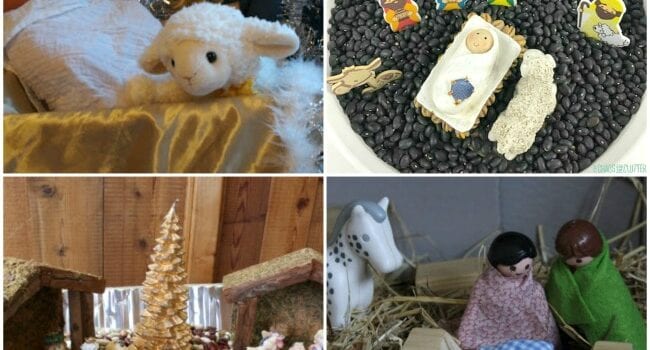
The holidays are a wonderful time to use sensory play. With all the hustle and bustle, it can become even more important for kids to have down time and sensory play allows them to do that. These Nativity sensory activities bring the true meaning of Christmas into that sensory play. a collage of different children's play opportunities with text that reads "Nativity Sensory Activities"
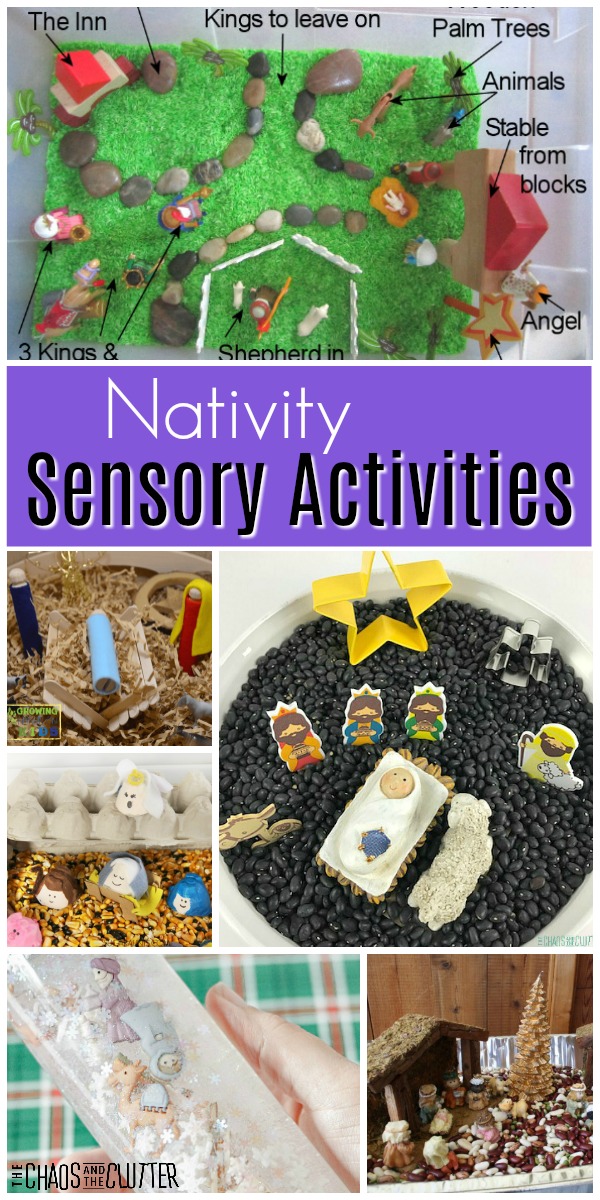
Nativity Sensory Activities:

Invite kids to engage both their creativity and senses with a station for Nativity Playdough.

A perhaps unexpected sensory play recipe is this one for Nativity Slime. It’s a favourite with kids.

Our Nativity Sensory Bottle Snow Globe is a great way to help kids focus on the Christmas story as they try to follow along by finding the corresponding items in the bottle.

We used the same buttons to create our Nativity Sensory Bag.

The Christmas story is the main event with the Sensory Nativity Story Box from The Fairy and The Frog.

Create your own Felt Nativity for kids to interact with like the one at Mama Smiles.
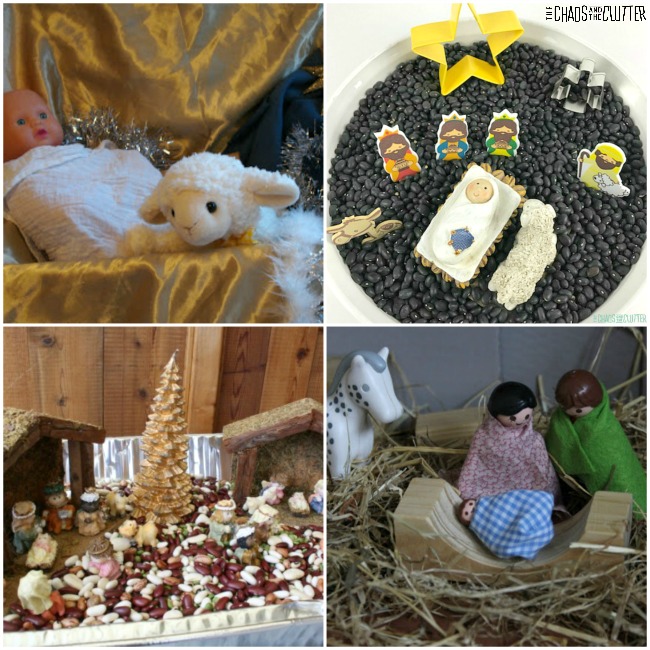
Nativity Sensory Bins:

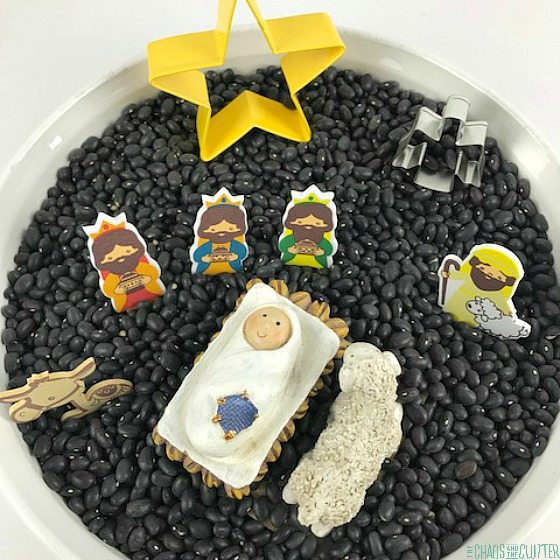
Our O Holy Night Sensory Bin is a very simple one that keeps the focus on baby Jesus. It costs next to nothing to put together.

The Nativity Sensory Bin at Growing Hands on Kids incorporates homemade elements so kids can really be involved in the process of creating the bin with you. It allows them to make Christmas crafts and then play with those in a very hands-on way.

Away in a Manger Nativity Sensory Bin from The OT Toolbox again begins with kids helping to create the elements that will be used inside the bin, this time making adorable egg carton characters and animals.

Catholic Icing shares their Playmobil Nativity Sensory Bin which has the cutest little stone walking paths and uses blocks to create the buildings.

Happy Hooligans Nativity Sensory Bin for Toddlers and Preschoolers uses any store bought nativity set that you already have so it can be thrown together in a flash.

Children can get in on the story telling with this Nativity Scene Small World Play from The Imagination Tree.

You might also be interested in checking out:
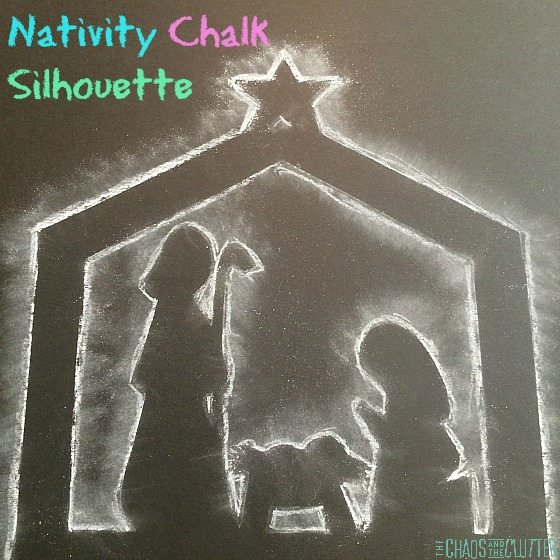
Nativity Chalk Silhouette

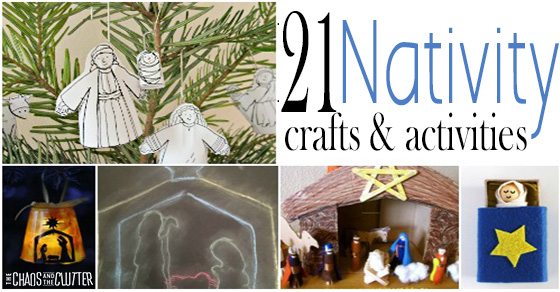
Nativity Crafts for ChildrenNativity Crafts and Activities to celebrate the season of Christmas

Filed Under: Christmas

Deconstructed Christmas Tree Sensory Bottle

By Sharla Kostelyk

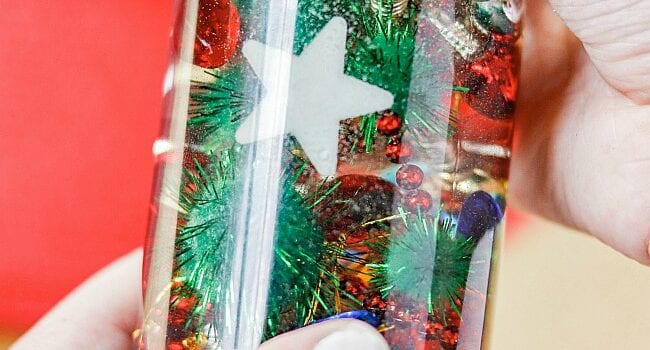
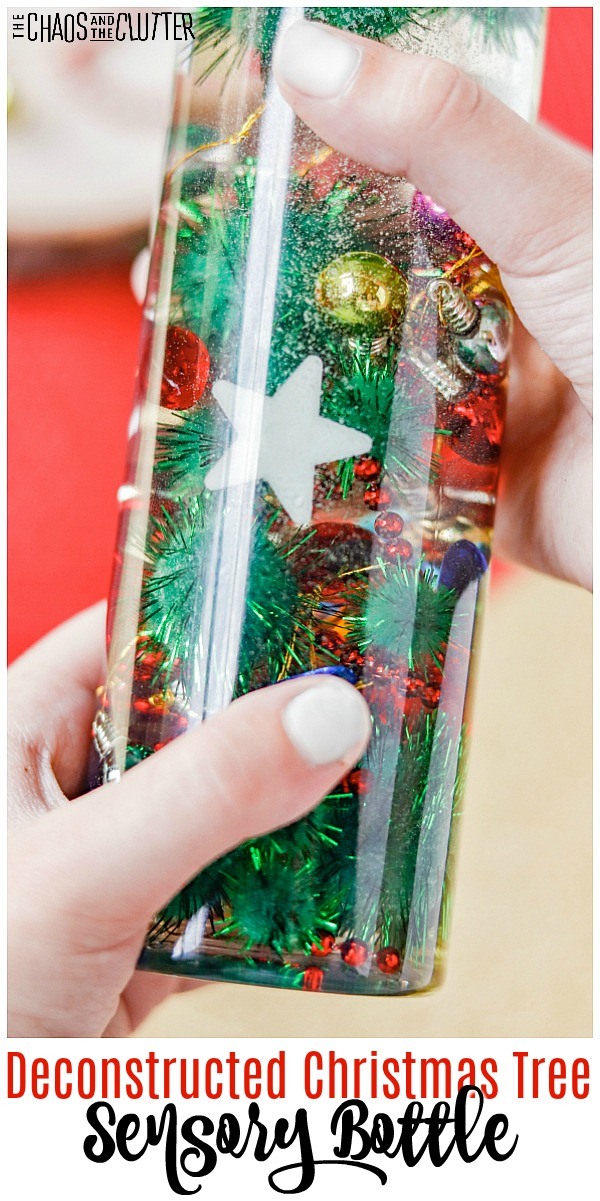
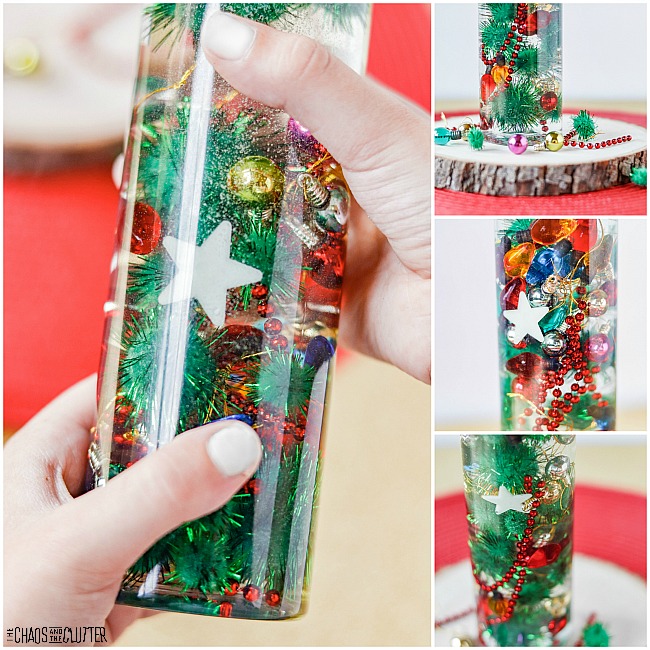
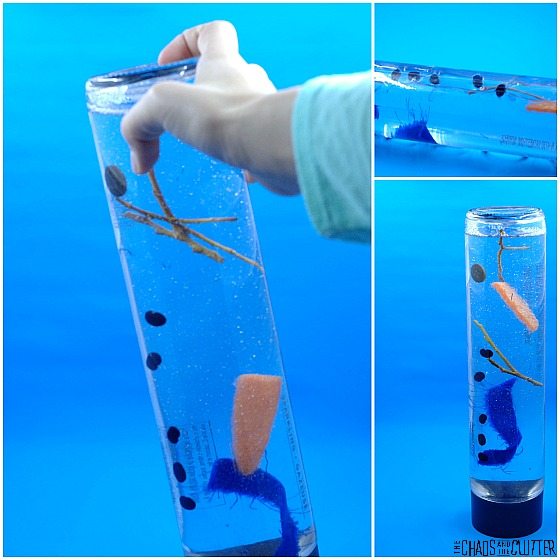
I am so in love with this Deconstructed Christmas Tree Sensory Bottle! It’s really simple and yet, it’s got this kind of whimsical quality to it that reminds me of something Dr. Seuss would have created. little hands hold a bottle full of green pompoms, tiny ornaments, and a star with text that reads "Deconstructed Christmas Tree Sensory Bottle"This is a great quiet activity for kids in amongst the hubbub of the holidays. Every year, I make several seasonal inspired sensory bottles for the kids like our Melted Snowman, Christmas Tree, and Nativity Sensory Bottles. They are small enough that kids can take it with them wherever they go.
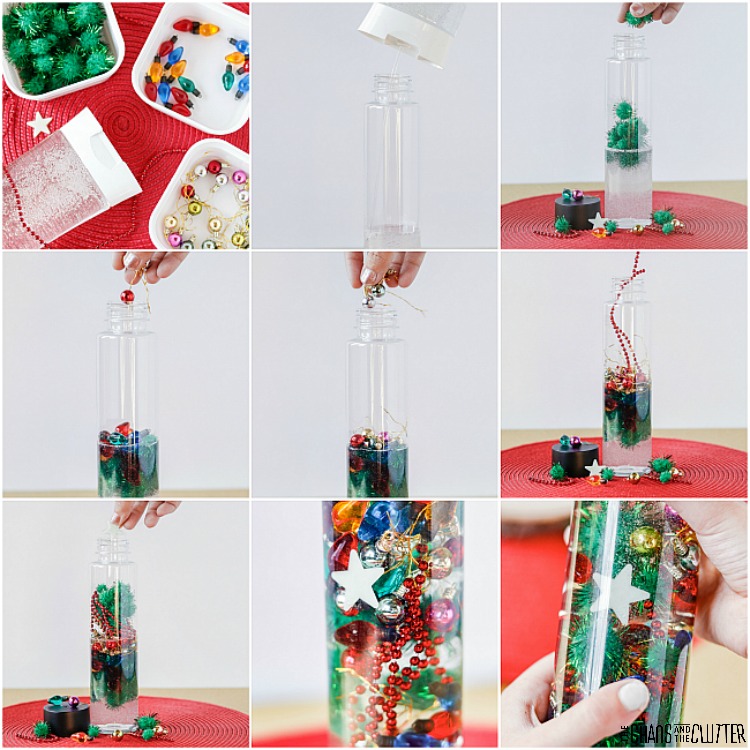
Deconstructed Christmas Tree Sensory Bottle:

Supplies needed:

  • empty plastic water bottle (I like the look of the Voss ones or sometimes you can find ones specific to sensory bottles at Michael’s)
  • clear dish soap
  • fuzzy green glitter pompoms
  • mini Christmas lights
  • mini Christmas ornaments
  • red bead garland
  • star
  • hot glue (optional)

Directions:

  1. Fill the bottle about a quarter of the way with clear dish soap.
  2. Add the pompoms.
  3. Drop in the mini lights, ornaments, garland, and lastly, top it off with the Christmas star.
  4. If there is any space left in the bottle, fill to the top with water.
  5. Replace the lid. If you’re using this with younger kids, hot glue the lid in place to secure.

You can find the supplies to fill this at the Dollar Store, Hobby Lobby, or on Amazon. Of course as with any sensory activity, adult supervision should be used at all times even if the lid is secured in place.
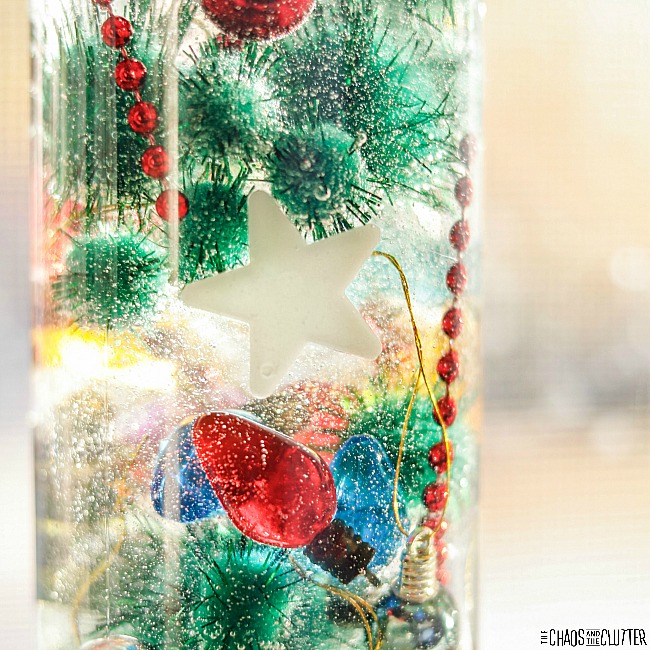
This really does look like a deconstructed Christmas tree in a bottle. It has all the decorations that would be on a tree, right down to the star topper. It even seems to almost look like it’s lit up when you hold it up to the light. It’s so cool!

Sensory and Learning Opportunities for Kids:
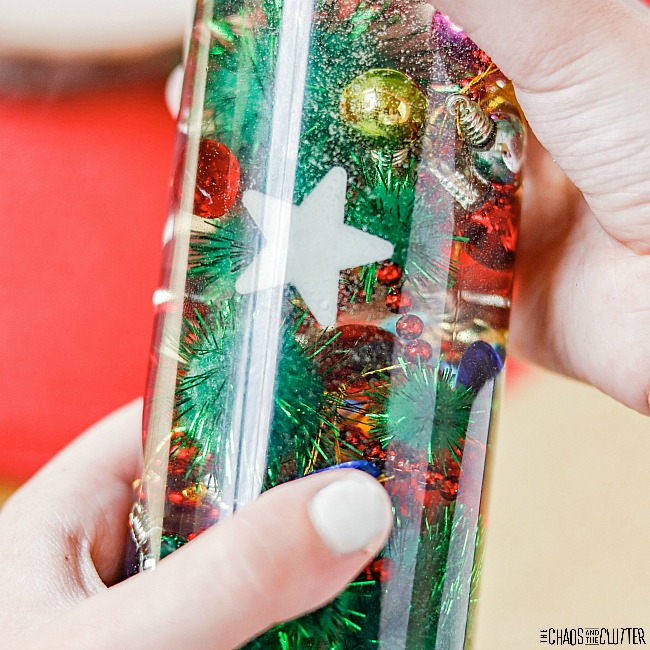
If preschoolers are playing with this, you can have them practise colours and counting but asking questions such as, “how many red Christmas lights can you find?” or “Can you count how many silver ornaments there are?”

Exploring with this sensory bottle engages the visual, tactile, and proprioception sensory systems. Sensory play is an important part of learning and development.

Check out these Christmas Sensory Bottles:

Nativity Sensory BottleMelted Snowman Sensory Bottle

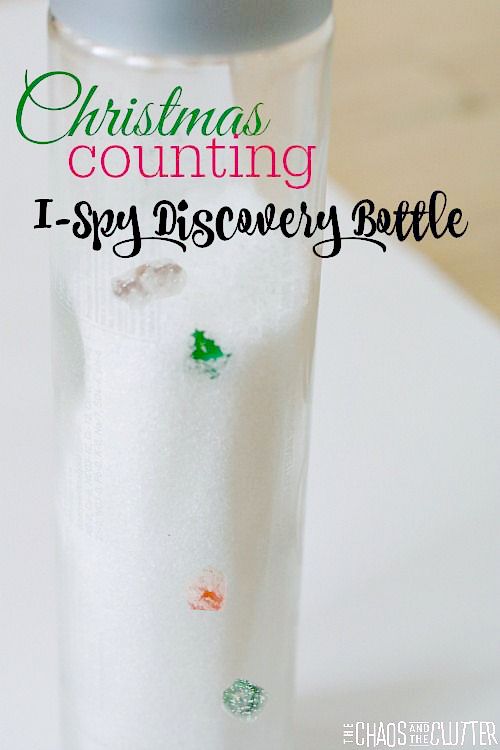
Christmas Counting I-Spy Sensory Bottle

Filed Under: Christmas, Sensory Tagged With: sensory bottles, sensory play

December Feelings Log for Kids

By Sharla Kostelyk

December can be full of wonderful holiday memories, but it can also carry with it a lot of worry and stress even for kids. The anticipation of Christmas, the change in routine, the extreme sensory overload, and the later nights can bring about some big emotions in kids that can be hard for them to pinpoint and even harder for them to express. That’s why this December Feelings Log for kids can be such a useful tool.

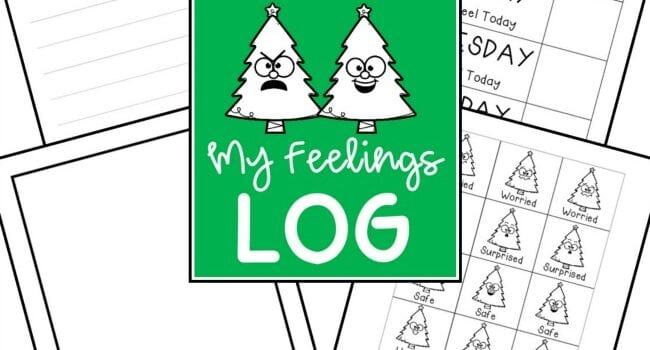
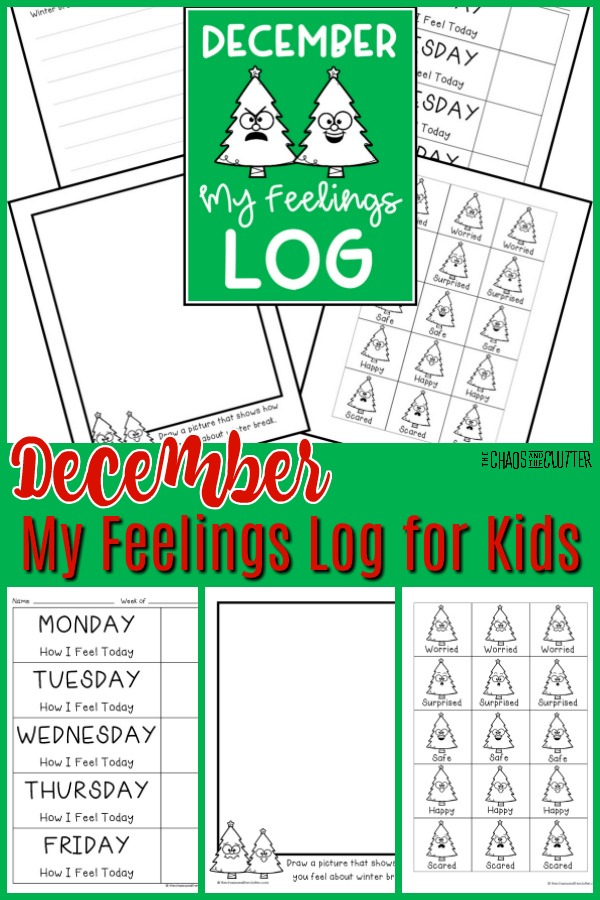
array of printable sheets with Christmas trees and words text reads "December My Feelings Log for Kids"When children are able to name and express their emotions, they are better able to manage them. It’s kind of like the first line of defence when it comes to challenging behaviours.
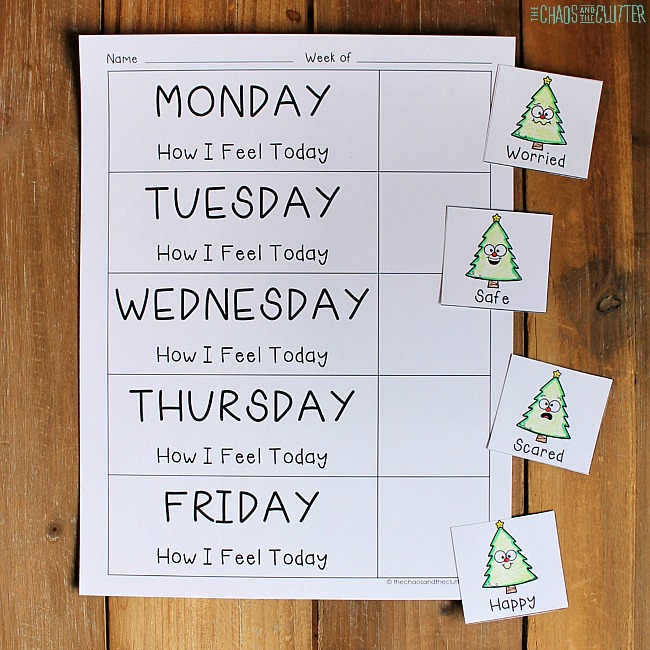
Giving them this tool can give them a leg up in beginning to express their emotions in healthy ways. It invites the child to consider their feelings about winter break (big change in routine) and to keep a record of how they feel each day. There are cute Christmas tree emotion visuals to help them better identify and sort out their own feelings.

Keeping a daily log allows kids to examine their emotions and it gives the opportunity for parents, teachers, or therapists to see if there are any obvious patterns emerging when looking back over the log. It’s a great tool!
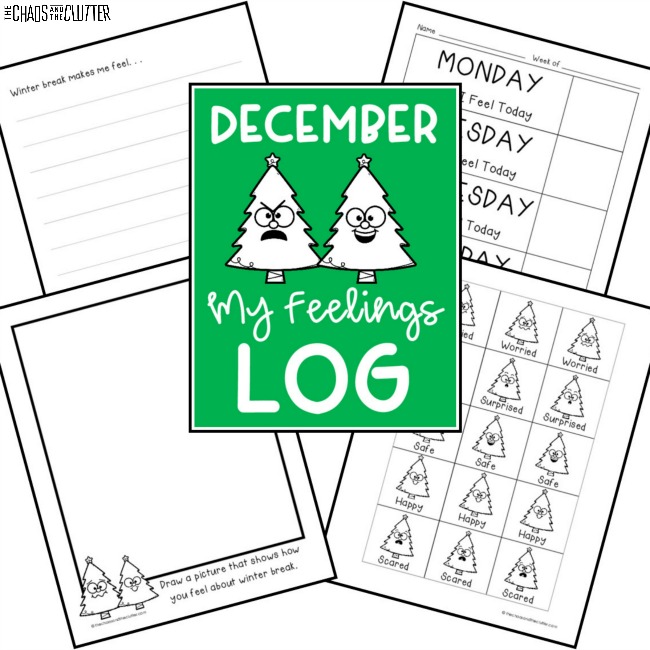
December Feelings Log for Kids:

Supplies needed:

  • printed Feelings Log (download here)
  • scissors
  • glue stick
  • markers, pencil crayons, or crayons
  • pen or pencil

I suggest you use the Feelings Log as a jumping off point. If you find there are several days in a row where your child has placed a more challenging emotion in their daily feelings log, you can use it as a conversation starter. This allows you to delve deeper into WHY they may be feeling the way they are and to come up with coping strategies together.

Perhaps have them draw how they are feeling about other events in December such as Christmas, an upcoming concert or performance, visiting relatives, or grieving the loss of a relative, pet, or friend who will not be celebrating the holidays with them this year. This can be so helpful.
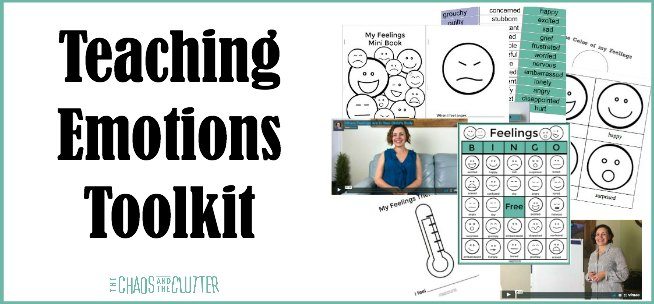
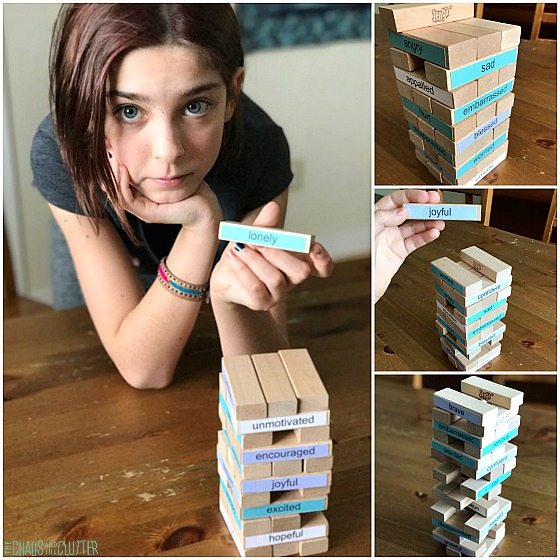
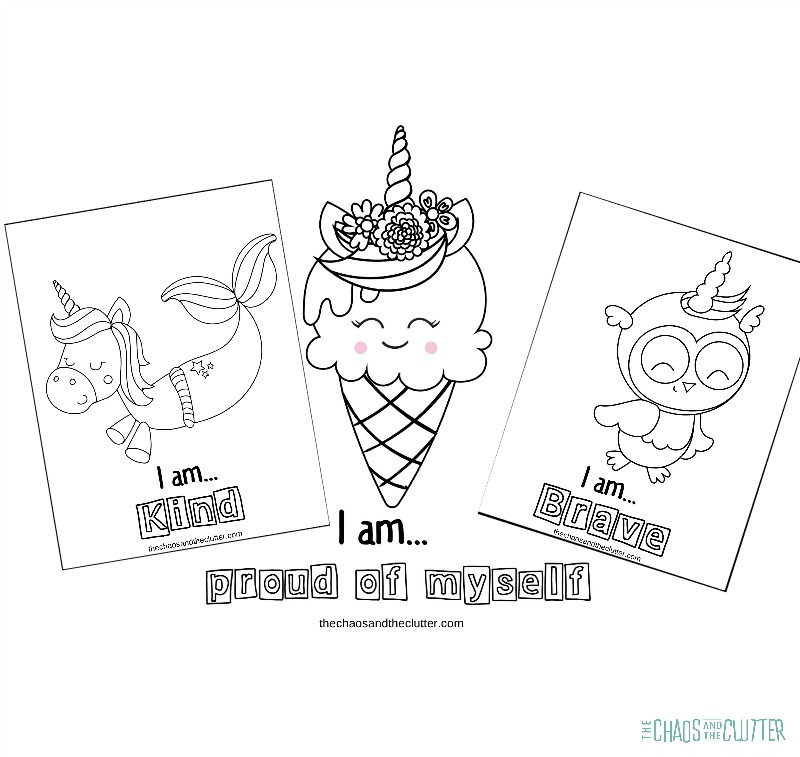
Just enter your email below to download your copy of the December My Feelings Log. You can use it with your child at home or print it off to use with your students in the classroom.

Check out these other resources for helping kids with their emotions:

Teaching Emotions Toolkit

Feelings Jenga

Unicorn Affirmations for Kids Colouring PagesUnicorn Affirmations

Filed Under: Parenting in the Chaos, Printables

The Sandwich Structure Theory

By Sharla Kostelyk

What if I told you that there is one change you could make to your parenting that could potentially make everything easier for your child? I’m guessing that you might be willing to give it a try even if it didn’t sound like all that much fun or if it went outside of your comfort zone.Sometimes the way we want to do things may not be what’s best for our child. That’s a hard realization to come to. When it first hit me that part of my parenting style was not what my child needed, it was hard to accept. Yes, it was hard because I felt guilty for not having met my child’s needs, but I’m going to be honest here and admit that that wasn’t the hardest part. The real hard part was that it meant that I was going to have to change. And change is hard.
You see, I was this fly-by-the-seat-of-my-pants kind of gal when it came to our days. I find schedules confining. While I’m a planner in most things, when it came to doing things with the kids, I was super flexible and we just kind of did whatever we felt like when we felt like it.

I was pretty strict with the whole bedtime thing because I coveted those nice, quiet evenings, but during the day, there was no set routine. We were homeschooling, so we got up when we wanted to get up, went on whatever field trips sounded interesting, ate lunch when it worked best that particular day, went to the park if it was nice outside, stayed in if it wasn’t, made crafts if the fancy struck us, read, watched TV, ran errands, sometimes threw some learning time in there. Essentially, we did what we wanted to when we wanted to.

(Of course, I’m only talking about our time. I don’t mean that our kids didn’t have rules and chores and all that good stuff. I’m just trying to paint the picture that no two days looked alike and I had no real plan. And that’s the way I liked it.)

We were basically unschoolers and while there is certainly nothing wrong with that, there came a point where that stopped working for us because…we had more kids. It wasn’t the “more” that was the issue. It was that with our older two kids, having no structure worked. They could function within that. Our subsequent kids needed structure.

It became more and more evident to me that this whole unstructured non-routine-routine was not what they needed. It may partially have been due to their personalities, but it was for sure mostly to do with their special needs and how important routine and predictability are for kids on the autism spectrum or who have FASD or ADHD or SPD etc.

I needed to take an honest look at their needs and realize that I was falling short on meeting them. Gulp. I was unintentionally hurting my kids by my lack of structure. I resisted change at first. I hoped there was another solution. But the more I watched my kids’ reactions, the more I realized what I had to do.

My kids needed routine. Maybe you’re at a point where you realize that your child does too.

Studies have proven that kids with family routines are more advanced socially and emotionally. They also help with executive functioning which is so important for success.

One of the things that reportedly causes children the most anxiety is the fear of the unknown. By creating a predictably routine to give them a solid foundation in their day, they can better handle the changes that come their way.

Even if you aren’t excited by the thought of having things more scheduled, it doesn’t have to be constricting.

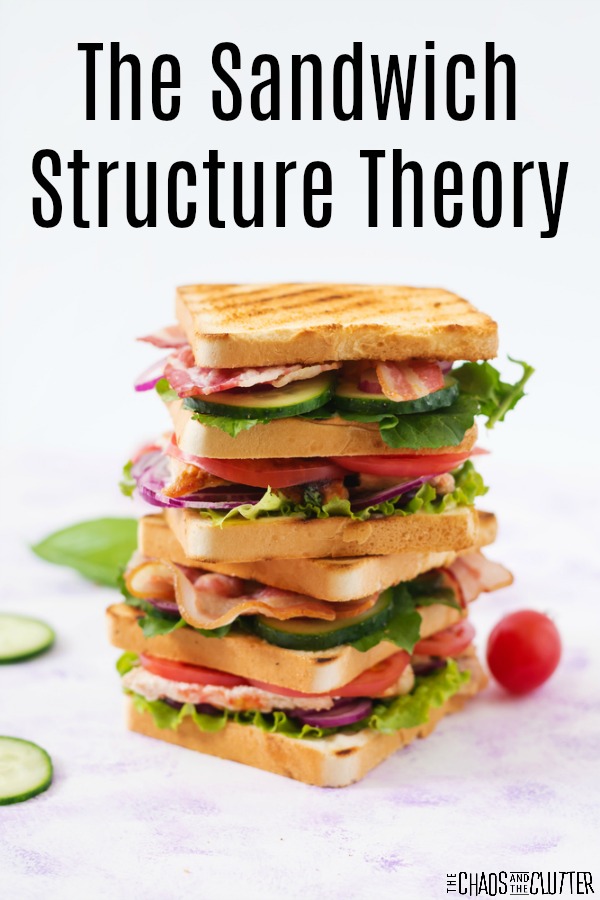
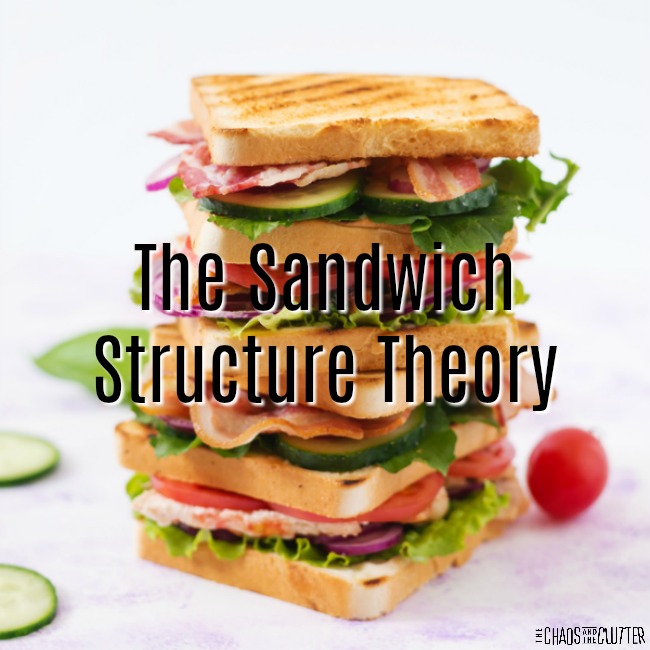
I knew that it wouldn’t work to put ourselves on a strict schedule. It’s just not who we are. But we needed to find a solution. That’s how I came up with the Sandwich Structure Theory. If you’re not a planner, organizer, in the box person, you can still meet your child’s need for predictability using this method. Think of it like a triple layer sandwich. You need the bread (structure) on top, in the middle, and on the bottom. That’s what holds the sandwich together. But the beautiful thing about doing it this way is that you can fill the sandwich with whatever you want in between the layers.
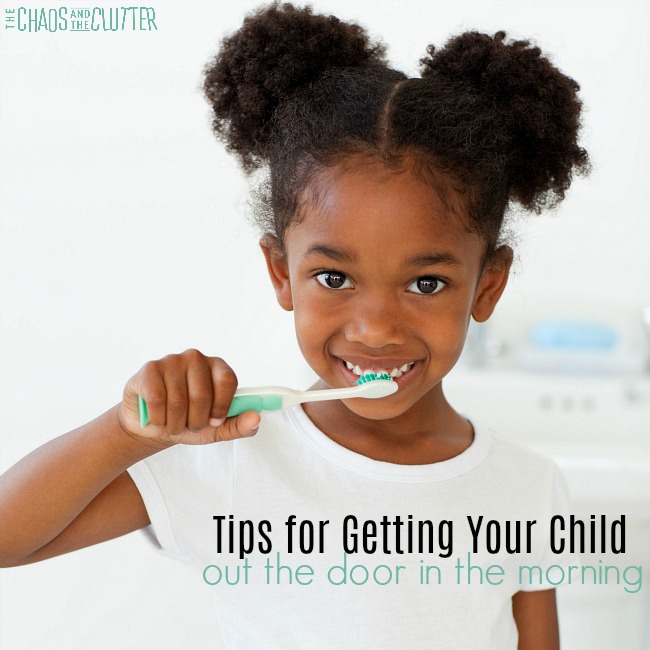
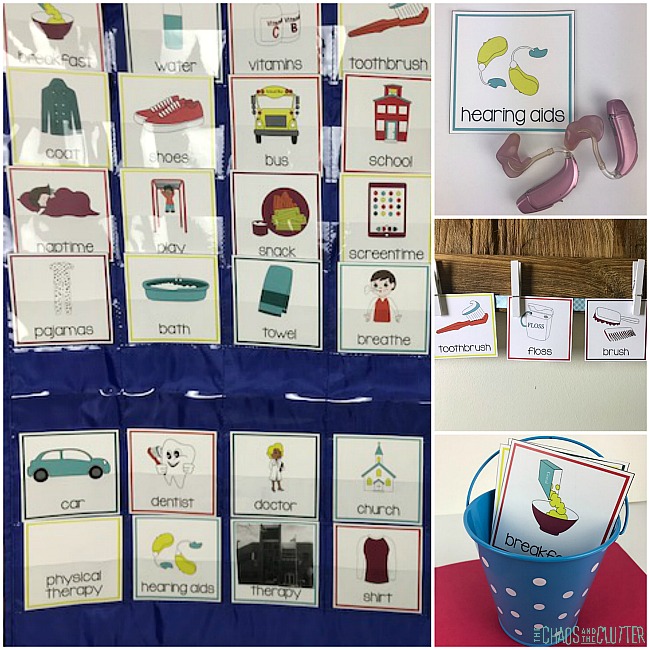
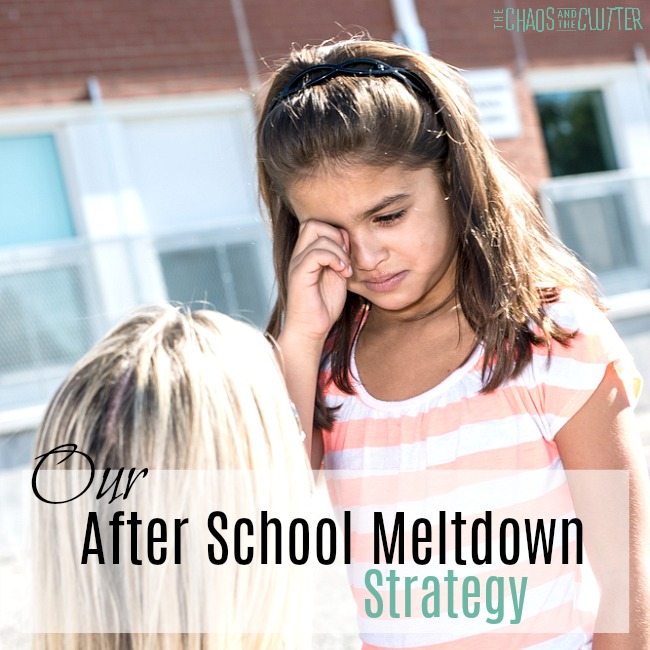
That means that if you have a strong morning routine (the top bread), a plan for after school to prevent those after school meltdowns (the middle bread), and a consistent bedtime routine (the bottom bread), you change up the in betweens (sandwich fillings) and your child will be better able to cope with those changes.

By creating consistency, you create a feeling of safety for your child so that they can thrive. Being able to predict what’s coming reduces anxiety. They can function better in those unpredictable moments if they know that the main structure is solid. So if there’s a change in their school day, knowing that when they get home, that first half hour is always the same allows them to accept those other changes more easily.

Of course, some children, particularly those with special needs, require more routine than just the “bread”. For those kids, I suggest using tools such as a visual schedule. I think of those types of tools as like the mayo of a sandwich. Some people just have to have mayo on every sandwich no matter what!

And if your child needs another “piece of bread” such as always having lunchtime or naptime (for younger kids) at exactly the same time, it’s easy to add that in.

So that’s basically it. My Sandwich Structure Theory is that you create some predictable parameters in the day that never change which then allows you and your child more freedom because other things in between those times can be more loosy-goosy and the structure will still create that felt safety.

You might also be interested in reading:

Tips for Establishing an Effective Morning Routine

Ways to Use a Visual Schedule

The After School Meltdown Strategy

Filed Under: Parenting in the Chaos, Special Needs Parenting

Nativity Sensory Bottle Snow Globe

By Sharla Kostelyk

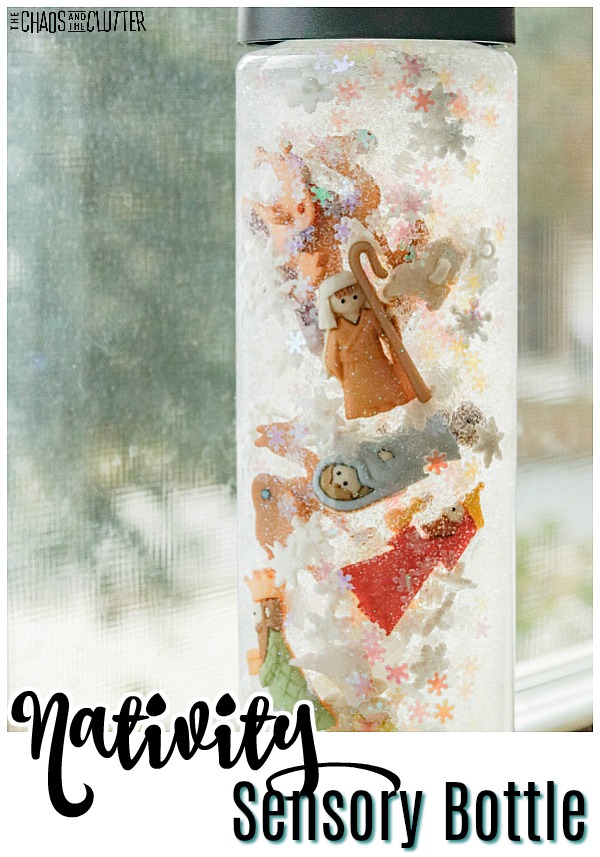
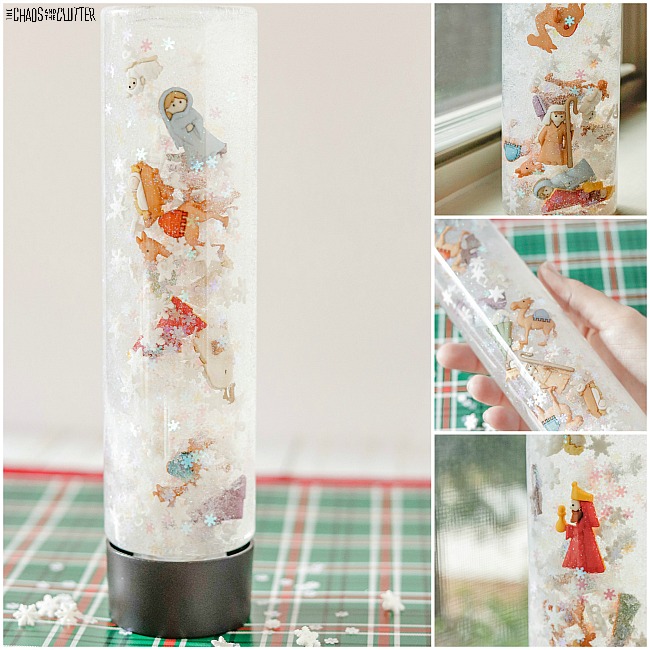
Is it weird to call a sensory bottle “beautiful”?! Because I really think this one is. The soft colours combined with the calming falling snow make this Nativity Sensory Bottle Snow Globe so pretty.

Sometimes parents can assume that the holidays are a time when kids don’t need as much sensory input because there are so many other things going on, but the opposite is actually true. With the change in routine and all the hubbub, children actually need more regular and varied sensory play to help them manage emotions and mitigate stress. We also use our Christmas Calm Down Kit for this purpose. clear bottle filled with clear liquid, falling snow, and the nativity icons with text that reads "Nativity Sensory Bottle"

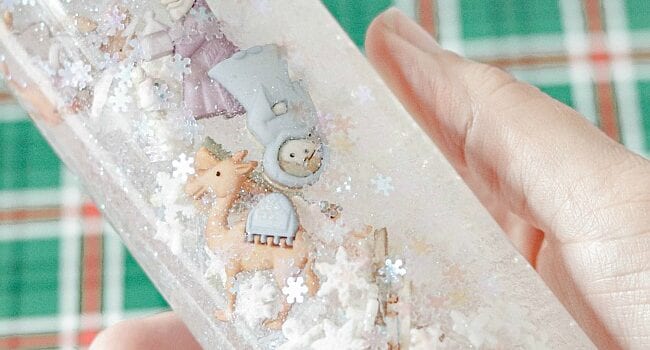
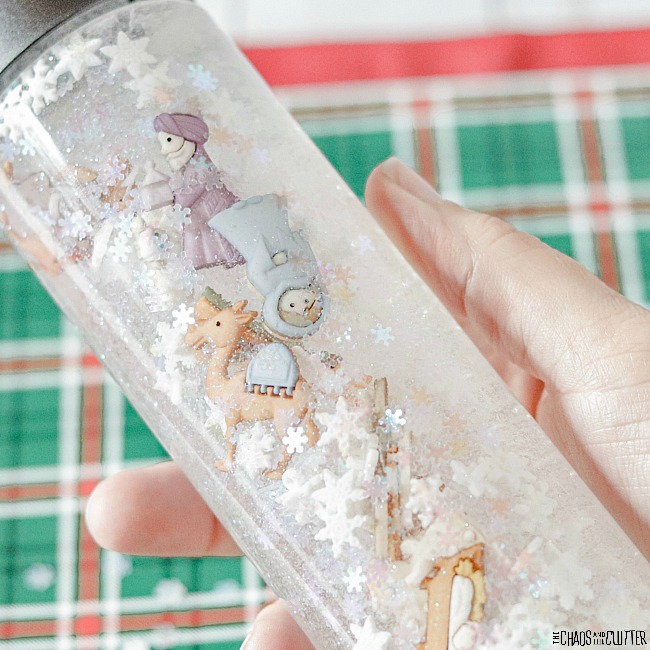
I love this Nativity Sensory Bottle as a holiday activity. It highlights the reason for the season. It also creates kind of a snow globe effect because of the snowflakes and glitter. And watching that fall helps kids (or adults) to regulate their breathing and feel more calm.

Nativity Sensory Bottle Snow Globe:

Supplies needed:

  • plastic empty water bottle (I prefer the Voss brand because I like the look or sometimes Michael’s carries plastic bottles for just this)
  • clear dish soap
  • white or opalescent glitter
  • small snowflake buttons
  • nativity buttons
  • We Three Kings buttons
  • The Good Shepherd buttons
  • super glue (optional)

Directions:

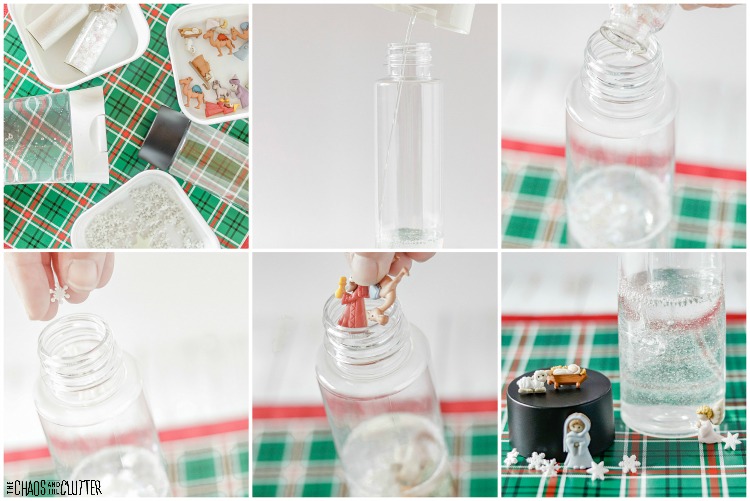
  1. Fill a plastic bottle about halfway with clear dish soap.
  2. Drop in some glitter.
  3. Add some of the snowflake buttons.
  4. Drop in all the people (buttons) that belong in the nativity scene.
  5. Fill the remaining space with water and screw on the lid.
  6. I suggest that you super glue the lid in place to prevent kids from opening the bottle.

Even if the lid is glued in place, determined kids can get it off and this contains small parts, so adult supervision is required when kids are playing with this.

Sensory Opportunities:

This sensory activity engages both the tactile, visual, and proprioceptive sensory systems. Sensory play is important for development, regulating emotions and behaviour, language development, and so much more.You can also play a game where as you tell or read the Christmas story, your child can find each character in the story as they are talked about. This is a great way to increase their interest and attention to the story. It allows them to participate and engage.

You may also be interested in these Christmas activities:

O Holy Night Nativity Sensory Bin

Nativity Chalk Silhouette

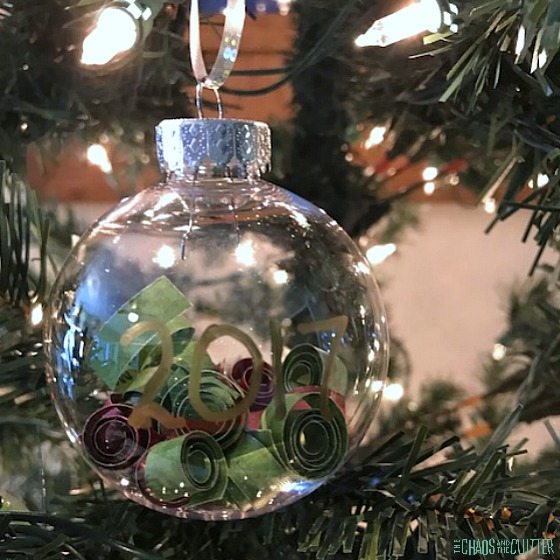
Time Capsule Family Ornament

Filed Under: Christmas, Sensory Tagged With: sensory bottles, sensory play

Santa Slime Christmas Gift Idea

By Sharla Kostelyk

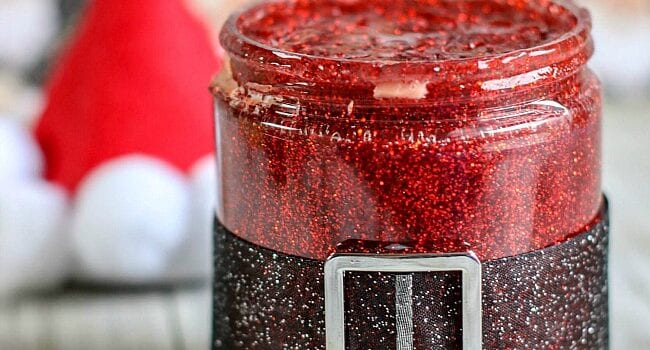
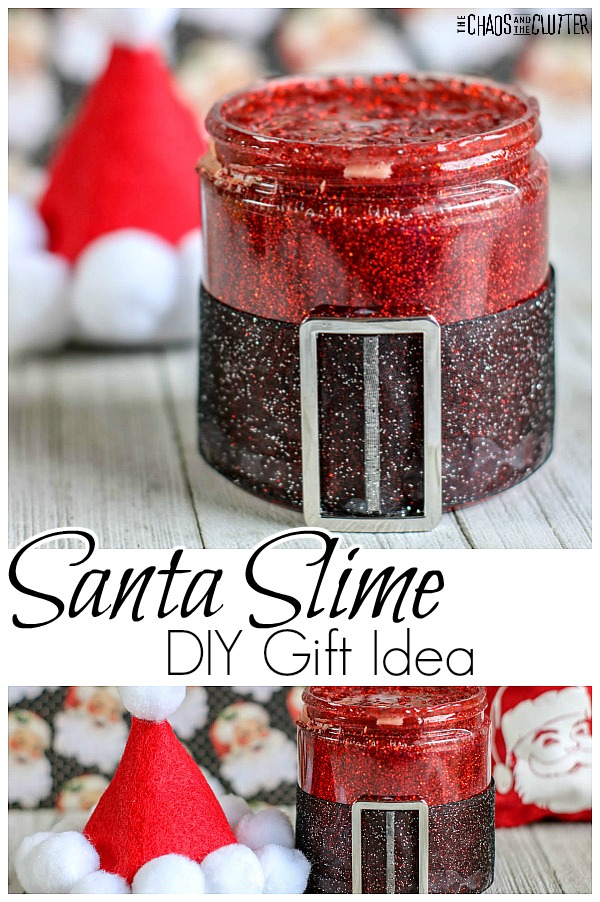
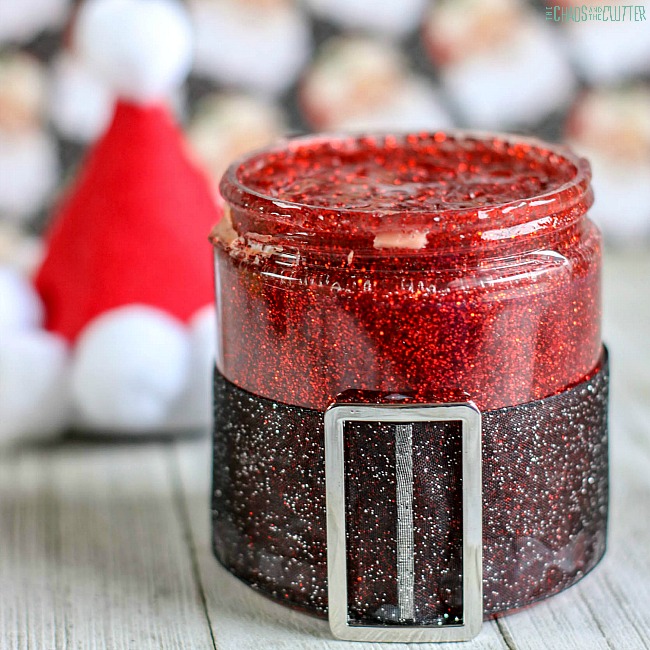
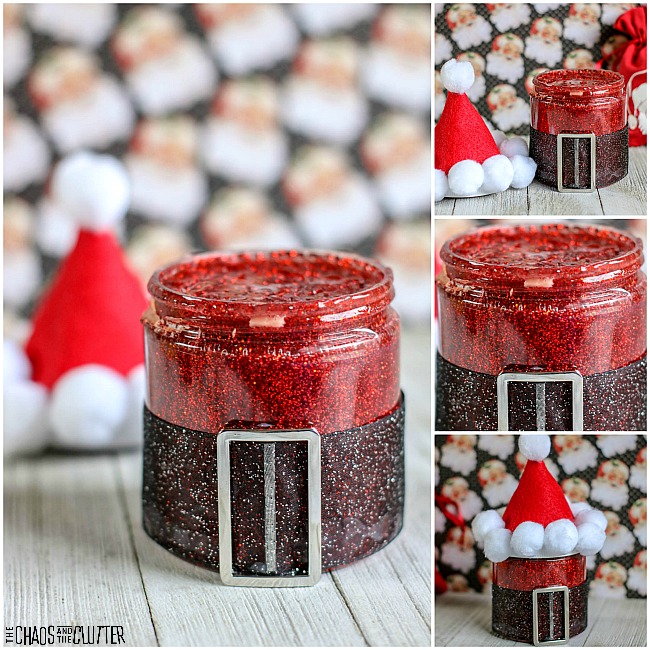
This Santa Slime makes such a cute DIY Christmas gift for kids to make to give their friends, cousins, or siblings. It’s a fun holiday crafting project to put together.jar with a Santa belt filled with red glitter slime with a tiny homemade Santa hat in the background with text that reads "Santa Slime DIY Gift Idea"

Santa Slime:

Supplies needed:

  • 8 oz. plastic storage jar with lid (you can sometimes find them at Michael’s or you can order them from Amazon here)
  • 6 oz. bottle Elmer’s red glitter glue*
  • about 1/2 cup warm water
  • ½ tsp. baking soda
  • 1½ Tbsp. contact lens solution (containing boric acid)

*If you can’t find red glitter glue, you can instead use clear glue and add a lot of red glitter.

For decorating the jar, you will also need:

  • 1 sheet of red felt
  • large silver slide buckle (used: Sew-ology at Hobby Lobby)
  • black ribbon (to fit the buckle)
  • white 1 inch pompoms
  • glue stick or hot glue

Slime directions:

  1. Empty the red glitter glue into a large bowl.
  2. Fill the empty glue bottle with 1/2 cup warm water and seal with the lid. Give it a few shakes to combine the remaining glue with the water. Pour into the bowl with glue and stir well to combine.
  3. Add the baking soda to the glue and stir to mix thoroughly.
  4. Squirt the contact lens solution into the glue mixture and stir well. (Note that regular glue will require less contact lens solution than glitter glue. Add the contact lens solution slowly, mixing between additions, and add only enough to bring the glue together into a soft ball.)
  5. Remove the slime from the bowl allowing any excess liquid to remain in the bowl. At this point, the Santa slime will be sticky. Start to play with the slime, kneading it as you would bread dough to bring the slime together. The slime is ready to use when it’s no longer sticky.
  6. When it’s not being played with, store the slime in an airtight container in the fridge.

To decorate the Santa jar:

  1. Trace the circumference of the jar lid on a piece of red felt. Cut it out. Glue it to the top of the lid.
  2. Trace around the outside of a 28 oz. can onto the felt. Cut that circle out and cut into two equal halves. Discard one half (unless you’re making two of these) and twist the other into a cone to form the Santa hat. Secure it with glue. Attach the hat to the lid with glue. Allow it to dry completely before attaching the pompoms.
  3. Glue the pompoms around the edge of the lid and one at the top of the hat. Allow the glue to dry.
  4. Measure the ribbon around the jar, leaving room for it to overlap slightly. Cut the ribbon there.
  5. Add the buckle to the ribbon and then glue the buckle and the ribbon to the jar. If you want the back of thee belt to line up with the back seam of the hat, put the lid on the jar prior to adding the belt.

Are you looking for other sensory play recipes for kids? Join us for a free five day email series on Sensory Activities and Solutions and get a sample of our Sensory Play Recipes eBook.

If you’re looking for other Christmas slime ideas, check out:

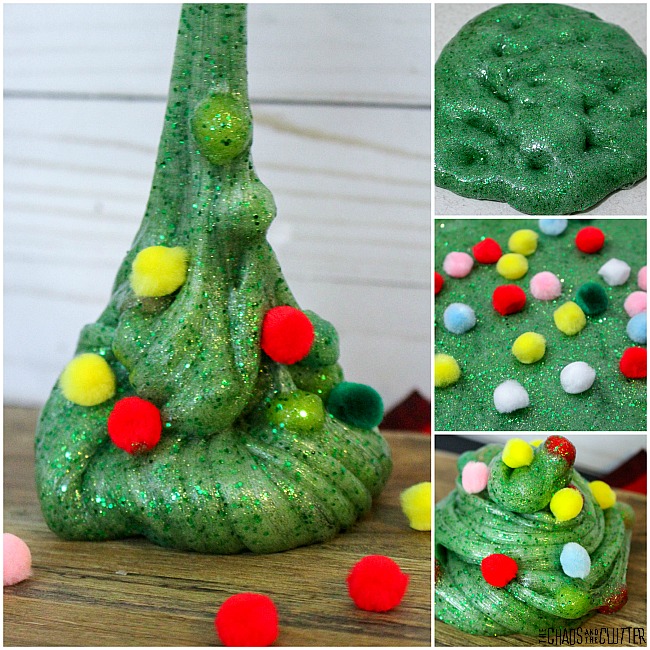
Holiday Scented Christmas Tree Slime

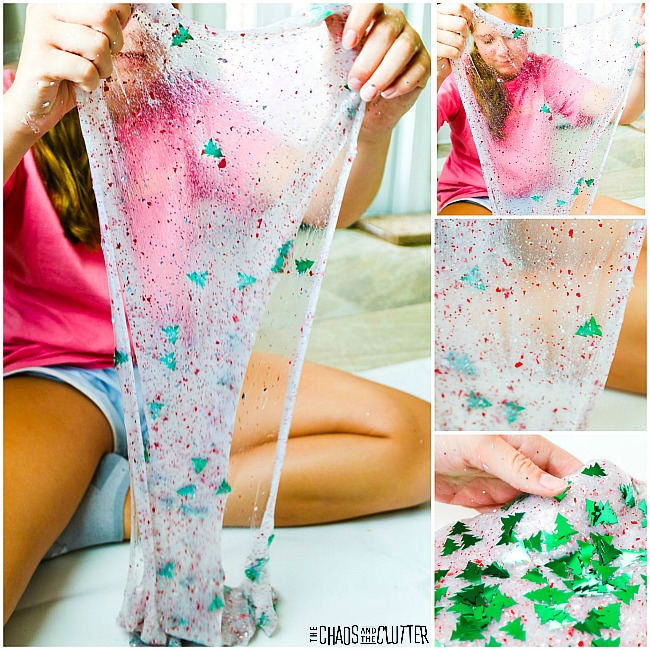
Stretchy Christmas Slime

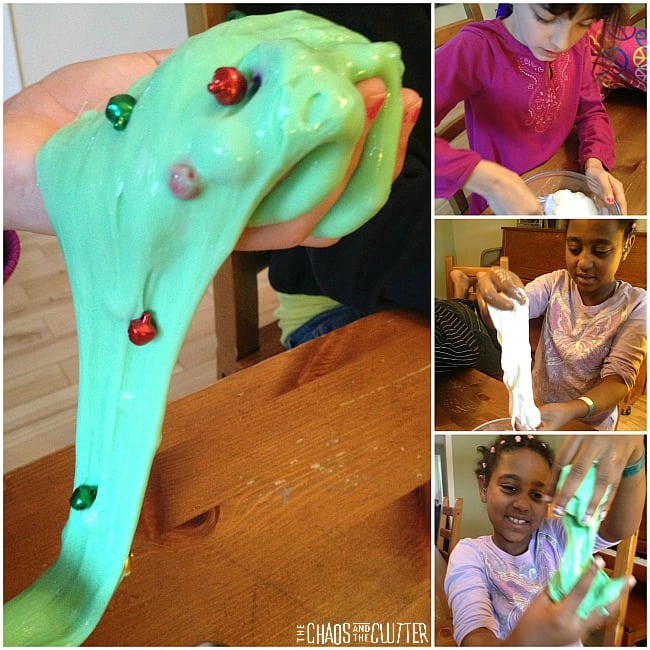
Holiday Jingle Bells Slimemaking holiday slime

Filed Under: Christmas Tagged With: slime

  • « Go to Previous Page
  • Page 1
  • Page 2
  • Page 3
  • Page 4
  • Page 5
  • Interim pages omitted …
  • Page 18
  • Go to Next Page »

Primary Sidebar

Categories

We are a participant in the Amazon Services LLC Associates Program, an affiliate advertising program designed to provide a means for us to earn fees by linking to Amazon.com and affiliated sites.

Copyright © 2026 • The Chaos and the Clutter • Site Design by Jeni @ The Blog Maven

Return to top of page

Copyright © 2026 · Chaos and the Clutter 2.0 on Genesis Framework · WordPress · Log in