• Skip to primary navigation
  • Skip to main content
  • Skip to primary sidebar
  • Home
  • About
  • Contact
  • Privacy + Terms
  • Affiliates

The Chaos and the Clutter

  • Facebook
  • Twitter
  • Pinterest
  • Google Plus
  • RSS
  • Email
  • School at Home
  • Sensory
    • Sensory Processing Disorder
    • Awesome Sensory Play Activities
      • Sensory Bins
      • Sensory Bottles
      • Sensory Bags
  • Family Games
    • Minute to Win It Games
  • Special Needs Parenting
    • Childhood Anxiety
    • Reactive Attachment Disorder
    • Sensory Processing Disorder
  • Store
  • Course Login

Adoption

7 Tips to Surviving Judgment as the Parent of a Child with Special Needs

By Sharla Kostelyk

It’s a Tuesday morning and you head to the grocery store. You’ve specifically chosen a Tuesday morning because it’s the least busy at this particular store. You have your list organized according to the layout of the store. You spend half an hour preparing your child for what to expect on the outing. You drive there armed with fidgets and stress balls with calming music playing softly in the background. You even let them wear the superhero costume without saying a word because you know it helps them both feel braver and feel more regulated because it fits tightly.
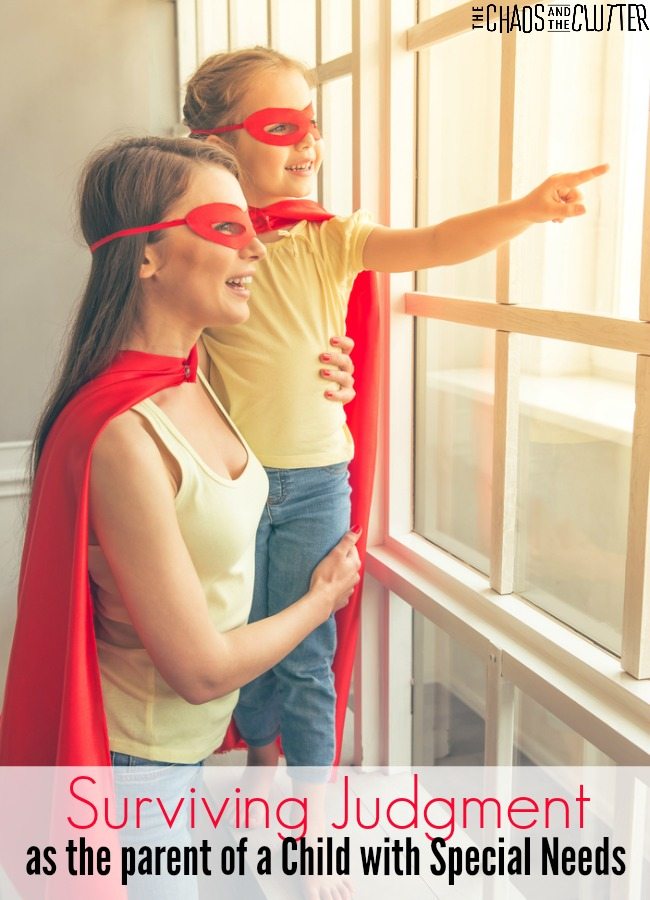
7 tips you need to survive the judgment from others when you are parenting a child with special needsYou have done everything you can think of to ensure this grocery trip is as pain-free as possible. You park. Take a deep breath. Turn around, smile at your child and together you walk in.

You get through the produce section with all its smells and unexpected mini sprinklers without issue. You mentally congratulate yourself for remembering to prepare your child for those potential pitfalls this morning!

You get through most of the aisles without anything dramatic happening. Even the cereal aisle is navigated without distress. You’re starting to breathe a bit easier now. You can see the end in sight.

You swing by the pharmacy where the kind pharmacist is very familiar with your family. Your child knows them well enough to respond and say hello. You can see that this has raised their anxiety just a bit and as you walk away from that counter, you check in with your child to see how they are managing. You tell them that you appreciate how well they are doing. You encourage them by showing them how much of the grocery list is complete.

In the dairy section, you see signs that the tension is mounting. There’s a temperature change and the lights are bright. It’s starting to get a bit more crowded in the store by now. Your child is touching everything you pass by and has knocked an item off the shelf.

You hand your child the list and a pencil and ask them to cross off what’s been found so far. You know that in doing so, you will give them a visual and tangible reminder of how close they are to being done. You will also give them something to do with their hands.

Your child comments that the wheel on the cart is squeaky. You are reading the back of a box trying to determine if it’s gluten free so you don’t respond right away. You move on towards the checkout but your child is standing back where you were, hands over their ears, screaming. You judge the distance between yourself and them and know that you will not make it in time to stop this from becoming a huge meltdown.

As you rush towards them, you mentally play back the trip to the store. Playing detective is an important part of your job as the parent of a child with special needs. You decide based on the evidence that it’s the squeaky wheels on the cart that were the final straw so you abandon your cart mid aisle and rush faster towards your child to help them calm down.

Out of the corner of your eye, you catch glares, a man shaking his head disapprovingly and a woman is approaching you, bent on sharing her “wisdom”. You know what’s likely coming. Not “good job mama”. Not “can I help?”

Judgment.

You’re well acquainted with the whispers, the glares and the outright rude comments. Years ago, you may have left the store in tears over her ignorant words, but not today. Today you know that her words are more a reflection of who she is than who you or your child are. Today, your only worry is your child. You’ve got this!

Tips to Surviving Judgment as the Parent of a Child with Special Needs:

  1. Breathe.
  2. Choose and practise a mantra that you can say internally. “They cannot steal my joy.” “I am the right mom for my child.” “They do not have the privilege of knowing my child.” “This is them, not me.”
  3. Know that you do not need to respond. It is not your job to educate the world at the moment your child needs you most.
  4. Better they judge you than your child. Often, it is tempting to explain your reasons, your methods, your child’s needs to save face. Sometimes it is appropriate to do so, but if your response is only going to further isolate your child and make them feel more different, you may need to risk being judged.
  5. Surround yourself with those who “get it”. Create a network of support people who understand. Those who have also walked this road are safe to share with. They can offer encouragement in a way that no one else can. If there is not a support group in your community, find one online.
  6. Keep track of your wins. Parenting a child with special needs can be discouraging at times because it’s often two steps forward, one and three quarters steps back. Celebrating your wins will help you rise above the judgment because you will have confidence that your child is moving in the right direction.
  7. Remember that you know your child best and that your child is doing their best. “They’re not giving you a hard time. They’re having a hard time.”

Join me for a free 5 part email series, Little Hearts, Big Worries offering resources and hope for parents.

This post is part of a Parenting a Child with Special Needs series with special needs moms who share their thoughts on “managing public situations.” These articles may help you navigate your way through your next time out in public.

How I’ve Learned to Manage Public Situations as a Special Needs Parent | My Home Truths

10 Tips for Running Errands with a Special Needs Child | Every Star is Different

7 Tips to Surviving Judgment as the Parent of a Special Needs Child | The Chaos and The Clutter

Navigating the Store with a Child with Sensory or Anxiety Issues | The Chaos and The Clutter

Dear Mom at the Park | This Outnumbered Mama

Dear Mom Who Is Afraid to Leave Her House | Kori at Home

How to Help a Mom When Her Child Suffers a Public MeltdownI Finding the Golden Gleam

Filed Under: Adoption, Sensory, Special Needs Parenting

To the Mom Whose Child Sabotages Mother’s Day

By Sharla Kostelyk

If you clicked on this article expecting cute stories of burnt toast and other breakfast-in-bed mishaps, this is not that article. If you are parenting a child with Reactive Attachment Disorder or early childhood trauma, this is for you.

For most moms, Mother’s Day is a day to be recognized, to be celebrated, or perhaps just an average day. For moms of kids with Reactive Attachment Disorder, Mother’s Day comes at a price.

My first five years or so of being a mom, Mother’s Day was breakfast in bed and sweet homemade cards. Once we began our journey of fostering and adopting, Mother’s Day changed. There was still the dog-pile of little ones jumping on my bed too early in the morning to wish me a “happy ‘movvers’ day” and gifts of macaroni necklaces or handprint art. But the holiday became significant in other ways as I considered the birth parents of my children and as I came to fully realize what a tremendous privilege it is to be a mom.

After our first three adoptions, Mother’s Day was a day that in my heart and in my words, I shared with other moms as I acknowledged the significance birth moms (though I just refer to them as moms) held for my kids and even for me. Were it not for them, my kids would not have life and I would not have the gift of loving them.

And then came our last adoption of two siblings who had a complicated history and who both suffered from Reactive Attachment Disorder and early childhood trauma…

Mother’s Day was no longer breakfast in bed and sloppy kisses. It was walking on eggshells and dodging the most hurtful words imaginable. It was having gifts broken and plans foiled. It was hours-long rages and buckets of tears. It was spite and venom. It was love rejected. It was dreams dashed. It was spending the day away from my kids rather than with them. It was questioning my abilities and worth as a mom.

If you are that mom whose child sabotages Mother’s Day, this is what I want you to know:

  1. It is not you they are rejecting. You are not the one who caused the trauma or inflicted the hurt. You represent the possibility of more pain if they risk loving fiercely again. It is that pain they are rejecting, not you.
  2. You love them well. If you didn’t love them so well, you wouldn’t be perceived as such a threat. In a way, their rejection is a reflection of just how effective your love is. Good job momma!
  3. You did not cause this. I’m so sorry that you have to bear the brunt of it.
  4. It’s okay for you to take a day to yourself. 364 days of the year, you give all that you have and then more than you have to give to this child. You deserve one day.
  5. I know that in an ideal world, you would want to be spending Mother’s Day with your children, but if you are parenting a child whose past causes them to sabotage this day for you, plan to be away for the day. Taking care of yourself doesn’t make you less of a mom.
  6. Stay off Facebook on Mother’s Day. Trust me on this one. You can thank me later.
  7. You are doing an amazing job. Parenting is never easy but parenting a child with trauma is hard, hard, hard and you are doing it. You need to give yourself more credit. You rock!
  8. Remember that their hurt comes from a place that is very real. This day is likely even harder for them than they are making it on you.
  9. It’s okay to acknowledge the pain that this causes you. You don’t deserve this and frankly, neither does your child.
  10.  You are not alone. There are other moms crying in their bathrooms at the same time you are.

What Mother’s Day looks like now in our house:

For a few years, we tried to continue our usual Mother’s Day traditions. It was just too painful and hard, not just for me but for my kids, both the ones suffering from RAD and for the others. For a few years after that, my husband would take the kids out for the day and I would spend the day alone which was better and not quite as triggering for our kids, but still left me feeling quite sad.

Then, I decided to make Mother’s Day more focused on others. I began making a nice brunch for my mom and my mother-in-law and keeping the focus on them, making it more of a grandmas’ day. This helped my kids somewhat. They were still triggered, but not to the same extent. I have since continued that tradition and added reaching out to a single mom each year and inviting them and their kids to the brunch. I find that by keeping the day focused on others, I don’t fall into the trap of feeling sorry for myself as easily. I do still feel nervous leading up to Mother’s Day and I have to work hard at not comparing mine to others (see #6 on the list), but the sting isn’t as strong as it once was.

P.S. If you want to be able to celebrate a Mother’s Day, make a secret one another day. Ask your spouse or a close friend to create your own special day midweek. Just be sure not to tell your child about it.

Join me for a free 5 part email series, Little Hearts, Big Worries offering resources and hope for parents.

What I Wish You Knew About being a parent to a child who has RAD (Reactive Attachment Disorder)What I Wish You Knew About Parenting a Child with RAD

Recognizing the Signs of Reactive Attachment DisorderRecognizing the Signs of Reactive Attachment Disorder

Filed Under: Adoption, Special Needs Parenting

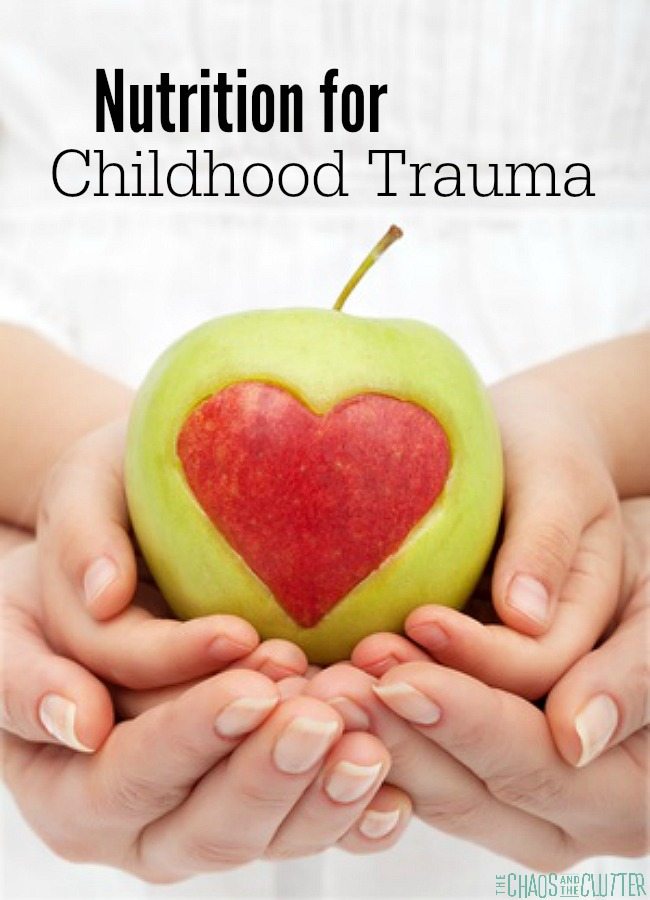
Nutrition for Childhood Trauma

By Sharla Kostelyk

Obviously, good nutrition is important for all children. For children who have experienced trauma either prenatally (such as prenatal exposure to drugs, alcohol or stress) or in early childhood, good nutrition is a critical component in their brain function and healing.

The importance of nutrition in children who have had early childhood trauma along with practical, specific tipsChronic stress can actually impact the way a person digests and absorbs their food so in children with higher cortisol levels due to early trauma, supplements may be needed.


When a child eats regularly scheduled nutritious snacks and meals, their blood sugar levels remain constant. This allows an optimal opportunity for learning and for regulating moods.

Dehydration causes all kinds of problems including decreased cognitive function, headaches, fatigue, poor concentration, increased anxiety, and mood swings. Getting enough water and reducing or eliminating caffeinated and carbonated drinks impacts everything from sleep to emotional regulation to playtime.

Ways to improve nutrition in children with trauma:

  • set a timer to remind yourself to give your child small healthy snacks
  • have a regular schedule for mealtimes so that they know what to expect
  • give each child a water bottle and keep it filled all day
  • remind them regularly to drink their water
  • model healthy eating by eating breakfast, lunch and supper yourself and drinking enough water

If you suspect that nutrition may be playing a role in your child’s behaviour, keep a food journal for two weeks. Document everything your child eats and what time and record behavioural challenges that correlate within a two hour window. Look for patterns.

If you see patterns that seem to correlate with behaviour issues, try eliminating that food from your child’s diet or try an elimination diet. Foods that are commonly associated with changes in behaviour are gluten, dairy, sugar, colourings, and additives.

Omega-3 fatty acids are especially important for children who have FASD (fetal alcohol spectrum disorder), ADHD or trauma. Studies show they reduce symptoms of anxiety, impulsivity, inattention, and learning difficulties. Omega-3 can be introduced through fish oil capsules, seafood, flaxseed oil capsules or flaxseed, raw almonds, raw walnuts, soybeans, spinach, and chia seeds.

Adopted children and food:

Food can be interlinked with trauma in children who have experienced neglect or were born into poverty and went hungry. Providing a feeling of safety in regards to food can take years. It is important for children, especially those who may not have had consistent access to food in their past to know that their physical needs will now always be met. Telling them that there will always be food for them is not enough. Show them where the food is in the house. Choose some food that they can have unlimited access to. In our house, this is fruit and vegetables, but when our internationally adopted children first came home, we also provided them with a box of snacks such as granola bars and nuts that they could have whenever they wanted. We always kept their water bottles filled so they would know that clean water would never be something they had to go without. Having very set snack times and mealtimes also helps to establish trust in the area of food.

Some children who have experienced neglect or hunger will hoard food or will eat to the point of being sick. Generally speaking, those types of behaviours will lessen once food is consistently provided but for some children, these behaviours can be long lasting. The brain is a powerful thing and sometimes even years after hunger, children will be in fear of being hungry and be hoarding food or overeating. If this is the case for your child, you need to talk to a doctor or mental health professional, particularly one who specializes in adopted children.

Malnutrition is also a consideration in adopted children who have experienced hunger. They will need supplements and a nutrient rich diet. They will also need healthy fats to help with their brain development and function. You may wish to consult with a nutritionist.

Adoption Nutrition is a website specifically for information for adoptive parents on nutrition. It also includes lists of what internationally adopted children may be deficient in depending on their birth country.

Join me for a free 5 part email series, Little Hearts, Big Worries offering resources and hope for parents.

This is part of a series with other special needs moms. This month’s topic was food or mealtimes. You can click on the links below to read their tips and experiences.

Food Issues: Are They Behavioral, Sensory Related or Medical? | Every Star is Different

How We’re Gradually Introducing New Food Into Our Son’s Restricted Diet | My Home Truths

Nutrition for Childhood Trauma | The Chaos and The Clutter

30 Things SPD Parents Secretly Wish You Knew About Their “Picky Eater” | Lemon Lime Adventures

Mealtime Strategies for Kids with Hyperlexia and/or Autism | And Next Comes L

How to Help a Non Verbal Autistic Child at Make Meal Time Choices| Kori at Home

The 7 Food Battles Not Worth Fighting About With Your Picky Eater with Special Needs | Finding the Golden Gleam

Filed Under: Adoption, Special Needs Parenting

What I Wish You Knew About Parenting a Child With RAD

What I Wish You Knew About being a parent to a child who has RAD (Reactive Attachment Disorder)

By Sharla Kostelyk

Parenting children who have RAD (Reactive Attachment Disorder) has been the single most challenging thing of my life. I had read about it, attended seminars about it, talked to other parents who were walking it, but none of that could have prepared me for the reality of it. Because I was not prepared even though I had all the head knowledge, it’s hard to write about this knowing that no matter how carefully I choose my words, they will not be able to fully convey what living this journey is like. I am also carefully structuring my sentences so that they speak in generalities and not about my children in particular.

What I Wish You Knew About being a parent to a child who has RAD (Reactive Attachment Disorder)I hope though that in sharing this, others who are parenting kids who have Reactive Attachment Disorder will maybe garner a bit more compassion and understanding from those around them who read this.

This is what I wish you knew about what it’s like to be parenting a child with RAD:

  1. Children with RAD present very differently outside the home. They are often described as “charming” and “delightful” by others when things in the home are decidedly different. This dichotomy can further isolate parents as they worry that others won’t believe them if they share what the child is like at home.
  2. Children with RAD often have poor boundaries and therefore are socially indiscriminate. What you may see as “friendly” and “cute” may actually be a case of mommy (or daddy) shopping. We would appreciate if you would direct our kids back to us if they try to hug you or sit on your lap. We realize that you are trying to help by picking them up or returning their affection, but you may be further damaging their attachment to us. When in doubt, ask us.
  3. We know in our heads that love will not be enough to fix this, but our hearts often feel differently so we try to pour enough love into our child to replace what is missing.
  4. Parents of kids with RAD carry tremendous guilt. It is a heavy burden to carry the weight of something that was done to my child by someone other than me in a time before I even met them.
  5. These parents second guess everything. I know that all parents second guess, but when you are parenting kids who have RAD, it borders on compulsive and it is draining.
  6. Parents of kids who have RAD sometimes (or often) think they are losing their minds. Kids who have RAD can be expert manipulators, Philadelphia lawyers and extreme triangulators. This can lead to questioning of one’s sanity and second guessing facts that you know to be true. It also puts great strain on marriages or relationships with other caregivers.
  7. Parents of kids who have RAD are proficient detectives in their own homes. They need to be in order to keep from going crazy (see #6 above).
  8. We are tired every minute of every day. Our child’s hypervigilance can cause us to also become hypervigilant as we attempt to avoid any possible trigger for them. Our child’s emotional needs are often greater than the capacity we have as human beings to meet them.
  9. Parents of kids with RAD don’t tell you how bad things are because they don’t trust that you would understand the reasons behind their child’s behaviour and they would rather suffer silently than have you judge them or their child. We don’t tell you the worst because we want to protect our child’s privacy. Whatever we are telling you, imagine it at least ten times worse. Words like “rage” and “aggression” may be codes for “completely out of control for hours” and “physically violent”. We may be sugar coating in an attempt to protect. I would rather have you think that I’m a bad parent than have you think that my child is a monster.
  10. We love our child who has RAD. It hurts our hearts to be constantly rejected by them, but we hold on out of hope that healing is possible. We sometimes see a glimmer of the wonderful child that we know is in there and it makes us fight all the harder to love them through this.

 Join me for a free 5 part email series, Little Hearts, Big Worries offering resources and hope for parents.

You may also want to read:

The Best Reactive Attachment Disorder Books

Recognizing the Signs of Reactive Attachment DisorderRecognizing the Signs of Reactive Attachment Disorder

Calming the Fight, Flight or Freeze Response in Your Child

Filed Under: Adoption, Special Needs Parenting

Recognizing the Signs of Reactive Attachment Disorder

Recognizing the Signs of Reactive Attachment Disorder

By Sharla Kostelyk

Last month, I was asked to take part in a year-long blog series on Special Needs parenting. The other bloggers participating are women that I greatly admire so I eagerly agreed to take part. The theme for the first month was “recognizing signs”.

I did not expect to be writing about the signs of Reactive Attachment Disorder because it is hard for me to talk about. RAD is the one diagnosis that I probably struggle with the most, both because it is the most challenging and because it is one that I never imagined we would be living through.

In the adoption world, Reactive Attachment Disorder or RAD is the worst case scenario. It is the mental health diagnosis that you are warned about, but the one that you think could never happen to your family. Like many disorders, there is a spectrum with some children being more severely affected than others.

I remember watching a documentary in a College Psychology class about RAD and the girl in it having no conscience and trying repeatedly to murder her adoptive parents. RAD is the stuff nightmares are made of. It is considered to be the most severe form of childhood mental illness.

Recognizing the Signs of Reactive Attachment DisorderIn our years as foster parents, we did take care of a few children who had been diagnosed with RAD, but it is different to know that you are the foster parent, a temporary home for that child, that you can take care of them and meet their needs but at the end of the day, if an emergency arises or if it becomes too much for you to handle, there is a social worker you can call who can step in.

When we began our journey to international adoption, we knew that the possibility existed for our child or children to have RAD, but we still didn’t think it would happen to us.

One of the reasons that we chose to adopt from Ethiopia was because we knew that children are generally highly regarded in their society, the children were well cared for in the Orphanages (unlike the horror stories you hear of in Eastern European Orphanages) and we heard that it was unlikely for these children to have issues with attachment. We were naive. There were many risk factors still present.

Any time a child is separated from their primary caregiver, moved to an Orphanage where they are one of dozens or hundreds of children and then moved to a different Orphanage, there are likely going to be attachment issues. Add in some childhood trauma and an adoption fraught with challenges and Reactive Attachment Disorder is almost a guarantee.

When we adopted from Ethiopia, we already had two biological children and three adopted children, so we were not new to parenting or to adoption. We were well versed in secure attachments and knew that in adopting older children, we would have to be actively working on attachment. We had plans in place for helping these children transition to our family and to help them attach to us. We assumed that with enough love, enough effort and enough time, we could help them heal and attach. 

Even while still in Ethiopia with our kids, we could see that the challenges were much more than we had anticipated. It was obvious that they were terrified of us. They flinched or lashed out anytime we got near them. By the time we got back to Canada, we were all exhausted.

We settled into our new life at home with seven kids and began to work at helping them adjust. That meant teaching them English, getting medical attention for things like parasites and fungus and accessing play therapy. Over the months, they seemed to be settling a bit and we thought that we could see light at the end of the tunnel. That was not to be. More accurately, the tunnel is just much longer than we thought.

I don’t want to share specifics or much of a timeline because I am attempting to walk that line between helping others who are walking this road and protecting the privacy of my children. I will share a few personal things from our story further down, but the following lists are general symptoms and signs of Reactive Attachment Disorder. Not all signs will be present in all children with RAD.

In our two kids who are diagnosed with RAD, they each present quite differently and they each have signs that the other does not. Neither of them has all of these symptoms.

Signs of Reactive Attachment Disorder:

  • anxiety
  • trouble sleeping
  • lack of boundaries
  • hypervigilant
  • extreme dependence
  • acts much younger than chronological age
  • underdeveloped conscience, lack of remorse
  • inappropriate responses (laughing or smiling when something is sad)
  • fake, not genuine
  • academic struggles
  • difficulty showing affection
  • disobedient
  • defiant
  • argumentative
  • controlling
  • bullying
  • aversion to physical touch
  • tantrums or rages
  • sensory issues or sensory processing disorder
  • withdrawal
  • lack of eye contact
  • incessant chatter
  • not asking for help when hurt, sick or needing assistance
  • socially indiscriminate
  • manipulative (can be excellent at triangulating adults)
  • frequent lying
  • blames others for their mistakes
  • irresponsible
  • physically and verbally aggressive or abusive
  • mood swings
  • depression

Children with RAD are at higher risk for SPD, cognitive delays, malnutrition, language delays, depression, anxiety disorders, and ADHD.

Early intervention is key. Reactive Attachment Disorder does not have to be a life sentence and the chance of healthy future relationships is possible.

Our Reactive Attachment Disorder Experience:

We saw signs of RAD in our Ethiopian born kids from the beginning, but we were in denial for a long time. I believed that with enough love, we could “fix” them. One of our kids showed classic signs of “mommy shopping” from the beginning, being overly affectionate with strangers and giving her best self to those outside our family.

Our daughter was literally willing to go with anyone and still shows these boundary issues almost seven years after her adoption. She has gone into strangers’ homes, strangers’ garages and would be willing to go into a stranger’s vehicle. We always have to supervise her for this reason.

Our kids showed many other signs as well. It became obvious that our efforts towards attachment were not going as planned. Things came to a crisis point and we were finally able to get professional help for our two kids from Ethiopia who were both diagnosed with RAD, PTSD (post traumatic stress disorder) and one also diagnosed with an anxiety disorder and the other with ADHD (both things are in the list of diagnoses that children with RAD are at higher risk for).

The kids each took part with us (separately) in a year-long intensive group for kids with trauma and attachment issues. We worked in the program with a team of professionals including a psychiatrist, OT, therapists, and others to help them find some healing. We came to the agonizing decision to add medication as a piece of the therapy puzzle. Even with medication and years of therapy, the kids have significant daily challenges.

We want to help them to reach healing in their journey. On bad days, I wonder if healing is possible, but I have seen glimpses that give me reason to hope.

Hope for Reactive Attachment Disorder:

Last November, we conducted a therapy camp for five of our kids at home based on many of Karyn Purvis‘ principles and methods. For one week, we unplugged, had therapy activities and exercises scheduled every 15 minutes or so for 9 hours a day plus family connection time every other waking hour. It was intensive, exhausting, challenging, and worth every second.

We saw tremendous gains in all of our “campers” in things such as communication, problem solving, sensory issues, and self image. We also saw gains in positive attachment signs such as willingness to ask for and accept help, eye contact and giving us glimpses into who they really are.

Of everything we have tried, it has been the Karyn Purvis model that we have found the most success with. We attended her Empowered to Connect conference in 2015 in Minnesota, have bought and watched all of her 13 videos many times, read her book The Connected Child and read many of the articles she has written.

Sadly, Dr. Karyn Purvis passed away after a long battle with cancer, but her legacy in working with children from hard places lives on. You can access articles, short videos, and articles on Empowered to Connect. The videos we have found especially helpful are on the TCU website.

Join me for a free 5 email series, Little Hearts, Big Worries which will provide you with resources and hope for parenting your child.

I am pleased to have joined a fabulous group of bloggers to bring you this series on Parenting Special Needs Children. Be sure to read their stories on recognizing signs in their children.

10 Early Signs of Autism | Natural Beach Living

How to Recognize Signs of a Mood Disorder in Young Children | Every Star is Different

Recognizing the signs – Childhood Trauma  | STEAM Powered Family

Hemophilia, Juvenile Arthritis, and Allergies… Oh my | Grace and Green Pastures

Myths About Recognizing Developmental Delays | Life Over C’s

7 Sanity-Saving Tips if You Think Your Child has Special Needs | B-Inspired Mama

When They Say It’s Just Your Parenting | This Outnumbered Mama

Signs That Your Early Reader Has Hyperlexia | And Next Comes L

How to Deal with the Unexpected Learning Disability | Kori at Home

Forgiving Myself for Denying the Signs of Autism in My Daughter | Parenting Chaos

Filed Under: Adoption, Special Needs Parenting

Body Tracing Affirmation Exercise

By Sharla Kostelyk

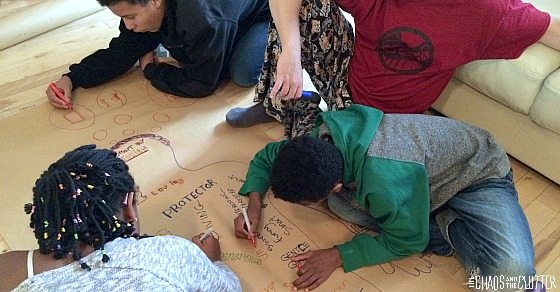
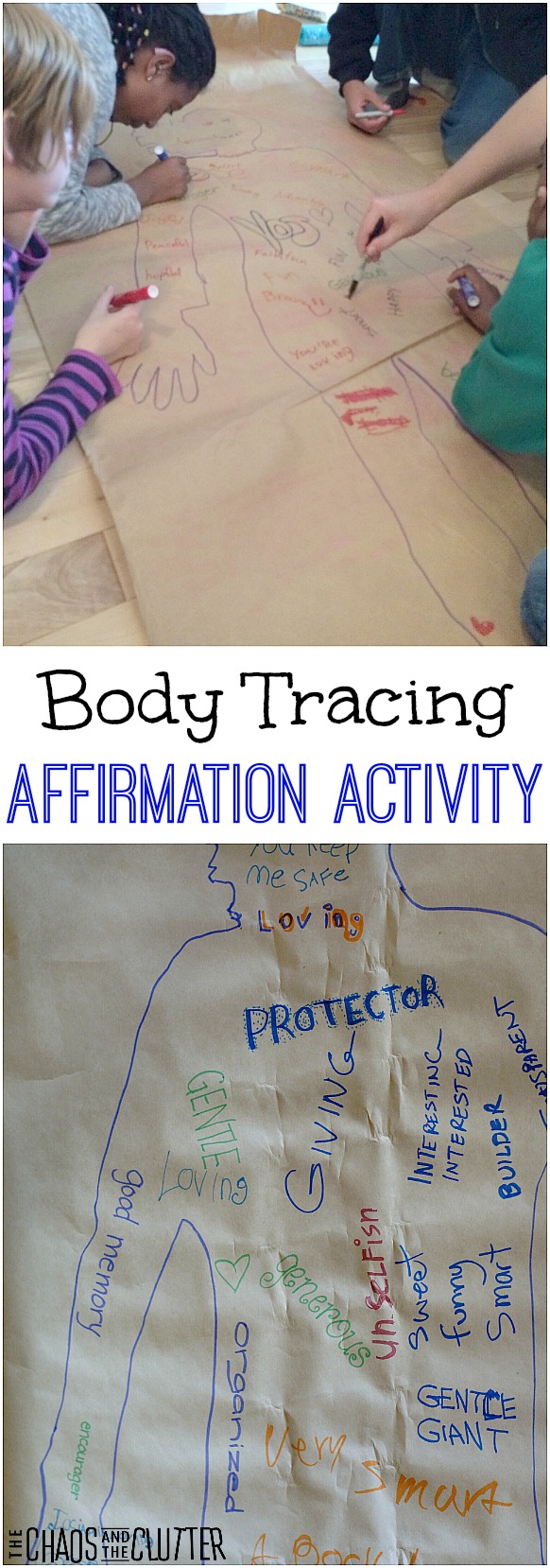
Body tracing can be a great way to foster connection with your child. This particular body tracing activity is particularly beneficial for kids with trauma histories, difficulty connecting with their family or siblings and those with self-image issues. This body tracing therapy activity provides positive reinforcement and also allows kids the chance to practise encouraging others and see themselves more positively.

This body tracing therapy activity provides positive reinforcement and also allows kids the chance to practise encouraging others.For kids with autism and attachment issues due to adoption, eye contact can feel threatening. This activity promotes eye contact and safe physical touch in a fun and relaxed way.
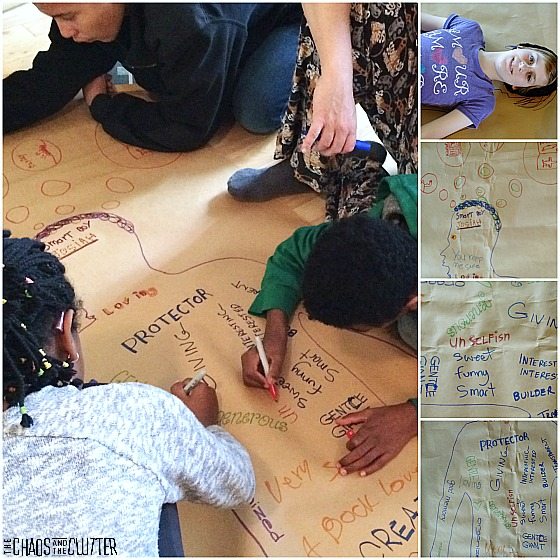
Materials needed:

  • butcher paper
  • markers (we used a pack of permanent markers)

We began this activity with a small talk with our kids about what would be an encouraging or positive word or phrase and gave them some examples. We wanted to decrease the chance that one brother may write something negative on another brother’s sheet!

To lower your child’s anxiety about this activity, it is usually best for you to be the one who lies on the butcher paper first. Your child can then use a marker to trace around your body. Once your body tracing is complete, get up off the paper and have everyone who is participating write positive words that describe you in the outline of your body. You also need to participate in this part and write positive words about yourself.

Writing positive words about yourself is one of the hardest things about this activity, but it’s important to model that for your child.

Next, it is your child’s turn to lie on the butcher paper. You know your child best. With some kids, you can joke light-heartedly while you are tracing them about their ticklish bits. However, for kids with abuse histories, you will probably want to trace more widely around them so that the marker doesn’t come into contact with any part of their bodies. While you are tracing them, be sure to look for opportunities to make eye contact and give them encouragement.

body tracing affirmation exercise squareNow it is time for everyone present to write words about that child in their body tracing. That child also writes positive words about themselves on their paper. Writing something positive about themselves was hard for some of our kids to do, but once they were able to write one thing, the rest seemed to come more easily.

Lastly, we got someone present to read all the words for each child in the form of “so-and-so is intelligent and cheerful and likes trains and…”. The child whose paper was being read was always beaming by the end.

I was worried about how some of our kids would do with this activity because as siblings, they don’t always have the nicest things to say about each other or to each other but they really caught the spirit of this and they all did an amazing job of building each other up.

body tracing therapy activityWe intended this to be a therapy activity that would boost self-esteem but I feel like it did more than that. There was a feeling of family togetherness and peace when we completed this activity. Afterwards, I heard our kids being more encouraging of each other and I heard less negativity in general.

This body tracing encouragement activity could be used in families, group programs, teams, or schools. It requires no prep, very few items and creates a sense of unity and affirmation.

Join me for a free 5 part email series, Little Hearts, Big Worries offering resources and hope for parents.

Anti-Anxiety Kit squareCreate Your Own Anti-Anxiety Kit for Kids

Filed Under: Adoption, Crafts and Activities

  • « Go to Previous Page
  • Page 1
  • Interim pages omitted …
  • Page 3
  • Page 4
  • Page 5
  • Page 6
  • Page 7
  • Go to Next Page »

Primary Sidebar

Categories

We are a participant in the Amazon Services LLC Associates Program, an affiliate advertising program designed to provide a means for us to earn fees by linking to Amazon.com and affiliated sites.

Copyright © 2026 • The Chaos and the Clutter • Site Design by Jeni @ The Blog Maven

Return to top of page

Copyright © 2026 · Chaos and the Clutter 2.0 on Genesis Framework · WordPress · Log in