• Skip to primary navigation
  • Skip to main content
  • Skip to primary sidebar
  • Home
  • About
  • Contact
  • Privacy + Terms
  • Affiliates

The Chaos and the Clutter

  • Facebook
  • Twitter
  • Pinterest
  • Google Plus
  • RSS
  • Email
  • School at Home
  • Sensory
    • Sensory Processing Disorder
    • Awesome Sensory Play Activities
      • Sensory Bins
      • Sensory Bottles
      • Sensory Bags
  • Family Games
    • Minute to Win It Games
  • Special Needs Parenting
    • Childhood Anxiety
    • Reactive Attachment Disorder
    • Sensory Processing Disorder
  • Store
  • Course Login

Special Needs Parenting

Surefire Clues Your Child has Sensory Issues

A little girl in a pink princess dress with blonde pigtails and a gold decoration in her hair sits with one leg crossed over the other on a grey outdoor staircase. The words "Surefire Clues Your Child has Sensory Issues" are overlaid on the image.

By Sharla Kostelyk

Do some of your child’s behaviours or reactions ever leave you scratching your head? Maybe you’ve noticed that their responses don’t seem typical for a child of their age or development. Your child may have sensory issues.

I still remember how helpless I felt watching our oldest daughter struggle when she was younger. Gracelyn came to us when she was just three days old, weighing 4 pounds and 14 ounces. It was love at first sight!

As she grew a bit older, some of her behaviours baffled us. She would spin around and around and around and never seemed to get dizzy. She would strip off her clothes in winter to put on a bathing suit just as we were about to walk out to door to get groceries. When we finally did get out the door to go shopping, she would reach out and touch everything on the shelves and even sometimes touch people as we walked past.

Surefire Clues Your Child has Sensory Issues #sensory #spd #sensoryprocessingdisorder #parenting #parentingtipsGracelyn had a freakishly high pain tolerance and it would sometimes lead to injury as she also seemed to have no concept of danger. She broke things by accident because she wasn’t aware of her own strength.

One of the many things she broke was the necklace I had worn at my wedding. I knew it was just a “thing”, but I cried nonetheless.

She would have meltdowns for what seemed to be no reason. She pulled down all the decorations in her room and started to pick holes in her walls. This girl was the pickiest eater I had ever met. To this day, the only fruit she has ever eaten is a banana. She didn’t seem to have any attention span and would flit from one activity to another, leaving a huge mess behind her everywhere she went.

She preferred to be upside down to being right side up. And upside down is how I was starting to feel my life was while I tried to figure out how to parent her!

Does my child have sensory issues?

If you’re a parent or caregiver who’s wondering if sensory might be the answer to some of the challenging behaviours you are experiencing with your child, I’ve put together a list that may help end the mystery or at least get you on the right path to uncovering answers for your child.

Note that some of the items on the list seem to contradict each other. That’s because in each of the sensory systems, your child can be hypersensitive or hyposensitive, meaning that they can be sensory seeking or sensory avoiding.

To make things even more confusing, a child can be sensory seeking in one sensory system and sensory avoiding in another!

Signs Your Child has Sensory Issues:

Does your child…

  • Chew on their sleeves or pencils
  • Complain of tags or seams in clothing or socks
  • Seem hungry all the time or never seem hungry
  • Have a hard time falling asleep
  • Cover their ears to block out noise
  • Spin in circles and never get dizzy
  • Bounce off the walls
  • Hide under desks or tables
  • Have frequent meltdowns over seemingly small things
  • Seem overly picky or have sensitivity to food textures or tastes
  • Want to wear gymnastic suits or bathing suits rather than clothes
  • Get distracted by background noise
  • Complain of headaches
  • Avoid getting their hands or face messy
  • Need to touch everything
  • Seem to not understand their own strength
  • Avoid hugs or hug too hard
  • Have difficulty concentrating
  • Cry about lights or sun being too bright
  • Fidget
  • Tire easily
  • Complain often of being too hot or too cold
  • Avoid grooming
  • Have a super high or super low pain tolerance
  • Gag easily
  • Avoid or seek out certain smells or textures
  • Have poor body awareness
  • Seem clumsy
  • Accidentally break things
  • Take their shoes and socks off at every chance
  • Hang upside down
  • Fear climbing or spinning
  • Constantly move
  • Prone to motion sickness or becomes dizzy easily
  • Wet the bed
  • Rage
  • Speak loudly (does not seem to have volume control)?

If you found yourself nodding at some of the items on this list, your child may be struggling with sensory issues or challenges. They may even have Sensory Processing Disorder. Speak to your child’s doctor or seek out the advice of an Occupational Therapist to help confirm this.

In the meantime, arm yourself with knowledge and strategies to help your child.

Can a child have sensory issues and not be autistic?

It is common for children on the autism spectrum to have sensory issues or SPD (sensory processing disorder). However, not all children with SPD have autism. In fact, many children with sensory issues do not have autism.

SPD is often a secondary diagnosis to autism, ADHD, RAD, and FASD. It is also found in children without any other diagnosis.

How can I help my child with sensory issues?

The most important step is to increase your knowledge about sensory. This will allow you to not only have the tools and skills to be able to help your child, but give you a deeper understanding of why their responses are the way they are.

Join me for a free 5 part email series Sensory Solutions and Activities. This will give you a solid foundation in sensory basics along with helpful tips and you’ll get the Sensory System Behaviours Easy Reference Cards.

Learn what you can. Here are some of the best books on sensory processing for parents.

Read 10 things you can do to make every day easier for sensory kiddos.

Teach your child about sensory processing so that they have the language to better explain themselves. This will also help them understand their sensory signals and preferences.

Learn to recognize the signs of sensory overload in your child. You’ll find this very helpful. This can also help you prevent sensory meltdowns.

This will start you on the path towards better understanding of your child’s sensory issues. You will gain the tools you need to be able to help them. Life for them and for you will start getting easier.

It can be overwhelming in the beginning, but trust me, it gets better. Our daughter (and 4 of our other kids who also turned out to have SPD) are all doing amazing now. There is so much hope.


Filed Under: Sensory, Special Needs Parenting

The Best of the Best Books on Sensory Processing for Parents

a woman sits on a bed with her legs outstretched in front of her. In one hand, she holds an open book and in the other hand, a red mug filled with coffee. Her face and upper body are not visible. She is wearing a blue shirt and tan pants and has on red nail polish. The words "The Best of the Best Books on Sensory Processing for Parents" are overlaid on the image.

By Sharla Kostelyk

When our daughter was a preschooler, I had never heard of sensory processing disorder. In fact, even the term “sensory processing” was foreign to me. This was the early days of the internet. But after watching our precious girl struggle every day, I was on the hunt for answers. I was able to get my hands on a few books on sensory processing for parents.

The Best of the Best Books on Sensory Processing for Parents #sensoryprocessing #spd #sensoryprocessingdisorder #specialneedsparenting #parentingbooksI devoured everything I could get my hands on. Unfortunately, a lot of the books I could find at that time were geared towards Occupational Therapists and other professionals. Sometimes, I felt like I needed a dictionary beside me to understand what I was reading.

But one of those books had a checklist in it. That checklist was like hitting gold! Going through it made it abundantly clear that sensory processing issues were at the root of many of our daughter’s struggles.

That was the day that I called and got a referral for our daughter to start seeing an Occupational Therapist. During the next few months, the OT came into our home weekly and taught me so much. I was able to adapt her environment and learn new ways of approaching things to better meet her needs.

Our daughter was diagnosed with Sensory Processing Disorder. With that diagnosis came a new understanding for all of us.

Over time, I learned how to meet her sensory needs and slowly, her challenging behaviours stopped. She became happier, calmer, and more in control of her body and her emotions. I was sold!

I wanted to do everything I could to help her. So I read more, attended seminars, asked questions. It’s a good thing that I did, because that knowledge would come in handy. Over the course of the next ten years, four more of our kids would also be diagnosed with sensory processing disorder.

Of course in most families, five kids with sensory issues would be unusual, but as SPD is often a secondary diagnosis to other things and we had adopted children with special needs, it turns out not to be that unusual in our case.

Sensory Processing Explained:

Years after making these discoveries with our daughter, I thought back on those early days. So many of the books I had read had used language I wasn’t familiar with. It was difficult to understand what I was reading and I had no idea how to apply what I was learning to our everyday life.

It was that experience that led me to begin writing about sensory issues here. That led to receiving dozens of emails from parents expressing their gratitude that I put things in a way that was easy for them to understand and actually use with their kids.

So last year, I teamed up with my good friend Heather who is an OTA. We dreamed of writing a book that was easy for parents and teachers to understand and that would make a difference in the lives of kids. We paired her OT knowledge with my experience of parenting kids with sensory needs and created a book that I’m so proud of.

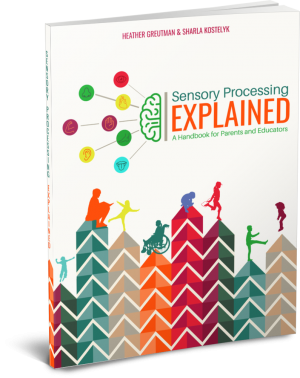
Sensory Processing Explained walks readers through sensory processing. It begins with the 8 sensory systems and details some of the basics. Once that foundation is established, it goes into practical tips and tools for everyday life scenarios. We took the struggles that our readers were telling us about and gave them solutions.

The book also includes a section for parents and another for educators with tips for both. There are also applicable printable resources.

Heather and I wanted to help kids by helping their teachers and parents better understand them and therefore better be able to meet their needs.

The Best Sensory Processing Books for Parents:

If you have a child that you suspect may have Sensory Processing Disorder, the first step I suggest you take is to speak to their Paediatrician or a qualified Occupational Therapist to have an assessment ordered. The second step is to get your hands on some good books on sensory processing.

When a parent or caregiver can understand sensory processing, they can better recognize their child’s sensory triggers. They can also learn to make accommodations to their home and lifestyle to better meet their child’s needs.

I highly recommend that you start with these books:

Sensory Processing Explained: A Handbook for Parents and EducatorsSensory Processing Explained: A Handbook for Parents and EducatorsBuy NowThe Sensory Lifestyle Handbook by Colleen BeckThe Sensory Lifestyle Handbook by Colleen BeckBuy NowThe Out-of-Sync Child: Recognizing and Coping with Sensory Processing DisorderThe Out-of-Sync Child: Recognizing and Coping with Sensory Processing DisorderThe Out-of-Sync Child: Recognizing and Coping with Sensory Processing Disorder

I will admit to being completely biased in recommending our book, Sensory Processing Explained, but I feel confident in suggesting it because of the incredible feedback we’ve received from parents, teachers, and therapists.

The Sensory Lifestyle Handbook is a deep dive into sensory diets. That term may not be familiar to you now, but the book will help you come up with a sensory diet strategy that fits your child.

The Out-of-Sync Child is an “oldie but a goodie”. This book helped me quite a bit way back when we were first starting out on our sensory journey (back in the day when SPD was still called Sensory Integration Disorder). The author is very well respected.

Once you’ve read these books, you should have a solid foundation of sensory processing and be well on your way towards better helping your child.

To learn more about sensory processing, join me for a free 5 part email series Sensory Solutions and Activities and get your Sensory System Behaviours Easy Reference Cards.

Filed Under: Sensory, Special Needs Parenting

Parenting Myth: You’re Only as Happy as Your Saddest Child

By Sharla Kostelyk

We were sitting in my kitchen. Mid-conversation, my friend said something that grabbed me. “You’re only as happy as your saddest child.” I nodded. The statement seemed like it must be true. What mother could be happy if her child wasn’t?

Parenting Myth: You're Only as Happy as Your Saddest Child #parenting #specialneeds #parentingtips #kbnThe conversation continued on to other things, but that statement stuck with me. I played it over and over in my head after she left.

Was I destined to always only be as happy as my saddest child? Would my happiness never again be in my control?

What she said had seemed logical at the time. What kind of mother would I be if I could find joy when my child was suffering?

But something about it gnawed at me. It didn’t sit right. At first, I couldn’t quite put my finger on why.

I’m the mom of 7. My kids all have different personalities. Some of them are optimistic and cheerful. Others are moody and see the glass as half empty even on the best of days.

Each of my kids have their own unique gifts and challenges. 5 of my precious kiddos have special needs, which give them additional obstacles to overcome.

Life can be hard enough without losing your hearing at 12 (one of our daughters), losing your first family and moving to a new country with strangers (2 of our kids), losing your hair as a 16 year old girl (another of our daughters) and on and on.

For days after that kitchen conversation, my friend’s words replayed over and over.

At the time, one of our children was especially struggling, so I wondered if I should be as unhappy as he was.

One evening, my husband and I were watching a comedy. I laughed out loud and then felt guilt creeping in. How could I be feeling carefree when one of my kids was in pain?

It took me weeks to sort through all of my thoughts and feelings. And I came to the conclusion that “you’re only as happy as your saddest child” is hogwash!

My happiness is my responsibility. It is not dependent on those around me or even on my circumstances. Of course, it’s easier to feel happy when life is going well.

If all my kids were themselves happy, if they were all making good choices, loving life, surrounded by good friends, not facing hardships that seem unfair and overwhelming, skipping merrily through valleys of unicorns and rainbows, I would feel less worried.

Being less worried would make it easier for me to be happy, but it wouldn’t necessarily guarantee it.

One thought I kept coming back to when I was contemplating this was that if my kids always see an unhappy mom, that will only make them less happy.

One of my jobs as  parent is to model positive traits for my children. If I want to teach them that they are responsible for their own happiness, that is something I have to show them.

If I want my kids to be able to find joy in the small blessings despite their circumstances, they are going to need to see a mom who was able to do just that. 

Choosing to be unhappy in solidarity with my “saddest child” won’t take their sadness away. In fact, it may compound it. And it places the burden of my happiness onto my child which is too heavy a burden for anyone to carry.

So mama, you are not destined to only be as happy as your saddest child. You are destined to be as happy as you choose to be.

I know that watching your child suffer is painful. It is gut-wrenching. Sometimes the unfairness of it can almost overtake you. But that does not have to rob you of your joy.

When your child sees you finding delight in just being with them, in counting the freckles on their nose, in watching the snow fall together, in snuggling on the couch, in playing a card game, even in the blessing of being able to cry together, they learn to find a bit more joy too.

Your smile is more powerful than your words.   

Some days, I get it right. I see the opportunities to infuse joy into my life. I take those and make the best of them.

Other days, I let my circumstances define my mood. I feel held hostage by things out of my control and pity takes up residence in my mind.

I haven’t got this thing all figured out, but I did some math. When considering the amount of kids I have and the challenges they currently face, I also thought about their personalities. Then I factored in future things such as spouses, careers, finances, in-laws, and their own children.

I pretty quickly came to the truth. If I were only as happy as my saddest child, I was never going to be happy again! And that’s not something to strive for.

So mamas, take that burden off. Unpack it, unbuckle it, unzip it, leave it at the door. From now on, choose to be “only as happy as you want to be”.

If you’re looking for strategies and encouragement on the parenting journey, join me for a free 5 part email series, Little Hearts, Big Worries offering resources and hope for parents. 

Filed Under: Parenting in the Chaos, Special Needs Parenting

10 Things You Can Do to Make Each Day Easier for Your Sensory Kiddo

By Sharla Kostelyk

Being a child with sensory needs can make even the simplest things like combing your hair or getting dressed feel challenging. Sometimes making small adjustments can make the everyday struggles easier.10 Tips to Make Every Day Easier for Sensory Kiddos #sensory #spd #sensoryprocessingdisorderAs a parent, you can feel helpless as you watch your child struggle. Using the strategies below, you can make life easier for your child and cut back on sensory meltdowns and day-to-day battles.
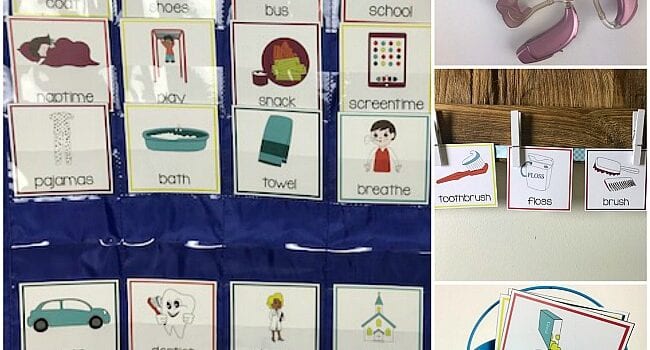
Here are some tips that can help with those everyday battles:

  1. Use a visual schedule. This allows the child to know exactly what to do and what’s coming next. It can ease the pain of transitions and lessen the chance of meltdowns. For some kids, they need the tasks broken up into smaller steps, so look for a visual schedule that breaks things down.
  2. Give warnings for upcoming transitions and allow for extra time so that your child can adjust. Be sure to allot margins in your day to allow for this and to reduce stress on both you and your child.
  3. Offer sensory breaks throughout the day. This gives your child the necessary sensory input. Sensory breaks also make good transition bridges.
  4. Use a Sensory Triggers Log to help you identify your child’s sensory triggers. This will allow you to avoid them or make changes to your child’s environment to accommodate them.
  5. Work on giving your child an emotional vocabulary so that they can express their feelings.
  6. Teach your child calming breathing techniques.
  7. Meet your child’s sensory needs during the day with sensory activities and heavy work opportunities. This will not only help them all day long, it will help them sleep better at night.
  8. Don’t die on the clothing mountain. Let your child wear what’s comfortable to them. Be a sensory detective to discover why certain articles of clothing bother them. This will help you find solutions.
  9. Have your child use a vibrating toothbrush. Not only will this add more sensory input to their day, it will decrease oral sensitivity and eventually lead to less battles over food.
  10. Teach your child about sensory processing and the 8 sensory systems so that they can better identify their needs and voice them to you.

Bonus tip: Carry a pack of Post-It notes with you in your purse so that you can cover the automatic flush sensor on toilets in public bathrooms. No more surprise loud noise for your child to contend with!

I love this list so much because it has some actionable strategies that you can start using right away.

Filed Under: Sensory, Special Needs Parenting

How to Use Visual Schedules with Your Special Needs Child

By Sharla Kostelyk

Does this sound familiar? You are trying to get your child out the door to school or for an appointment and they can’t seem to accomplish the smallest tasks. They are easily distracted and moving as slow as molasses. You give reminder after reminder, but they seem to go in one ear and out the other. It’s the same scene every morning. You are becoming more and more agitated until finally, you explode. Learn how to use visual schedules to ease transitions, reduce meltdowns, create independence in daily life, and make mornings more peaceful. #specialneedsparenting #sensory #visualscheduleYou feel guilty as your child leaves for school once again feeling deflated.
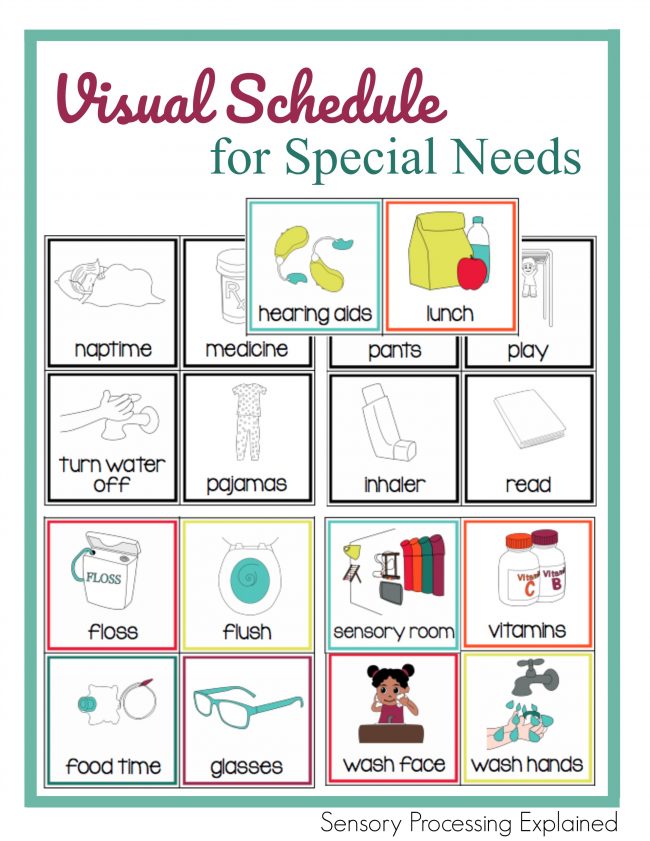
Your child can’t move from one activity to another or one location to another without having a meltdown. You try to remember to give them a “five minute warning”, but sometimes there just isn’t time. Sometimes, even with the warning, they still don’t seem to be able to make the transition.

You find yourself once again dealing with a meltdown.

The teacher calls again. Your child came out of the bathroom at school with their pants down around their ankles. Again. At home, they always forget to flush the toilet or leave the water running after they wash their hands…when they remember to wash their hands at all. You know that your child is doing their best.

You wish you could help them gain more independence.

Why use visual schedules?

Visual schedules carry many benefits, particularly for children who have special needs. Visual schedules:

  • break down tasks into easy-to-complete steps
  • simplify
  • provide structure
  • create predictability
  • teach independence
  • improve focus and attention
  • help with time management
  • instill consistency
  • form healthy habits
  • reduce cognitive load
  • maintain daily routines
  • establish a schedule that works
  • ease transitions
  • prevent meltdowns
  • promote positive choices
  • decrease problem behaviours
  • provide helpful reminders

Visual schedules are especially beneficial for children on the autism spectrum, children with FASD, ADHD, sensory issues or SPD, RAD, or other special needs. They can be an invaluable tool. Many parents report that they have been a “game changer” in their household.

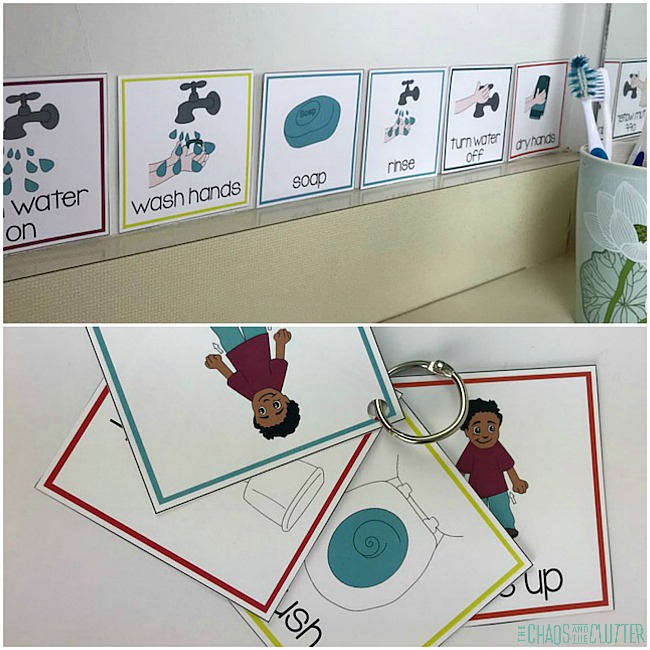
I created the Printable Visual Schedule for Special Needs because I couldn’t find a visual schedule that included what I was looking for to use with my own kids. I wanted something that parents could use with visual and written prompts that kids could easily understand. It is in both colour and black and white. The black and white cards are great for having kids colour themselves. This gives them another reenforcement and reminder.

How to use visual schedules:

The best way to use visual schedules to benefit your child depends on your child and on what you are hoping to accomplish.

If your child is experiencing a lot of meltdowns during transition times, you will want to start with cards that help them predict upcoming changes throughout their day to help them predict what’s coming next.

If your child is struggling to get out the door in the morning, you’ll want to start with cementing a morning routine that works for them.

Or if your child is struggling most with breaking things down into smaller tasks, that will be where you want to start.

Create a morning routine chart.

You can do this in many ways. Choose which of the methods below you feel would work best for your child. You can always try multiple methods to find the best fit.

  1. Place velcro dots on a poster board and hang the poster in their bedroom. Attach an open envelope to the bottom of the poster. Place velcro dots on the back of the visual schedule cards and place them on the poster in the order your child should complete their morning routine. As they complete the tasks, they can add the card into the envelope.
  2. Hole punch the cards that your child needs to complete each morning. Place them on a binder ring and give it to your child as a visual reminder they can carry with them as they complete each step.
  3. Affix magnets to the back of the cards. This works best if the cards are laminated. Set up an area on the side of the fridge or on a magnetic white board in the kitchen where your child can see their cues and move them down as they complete each one.
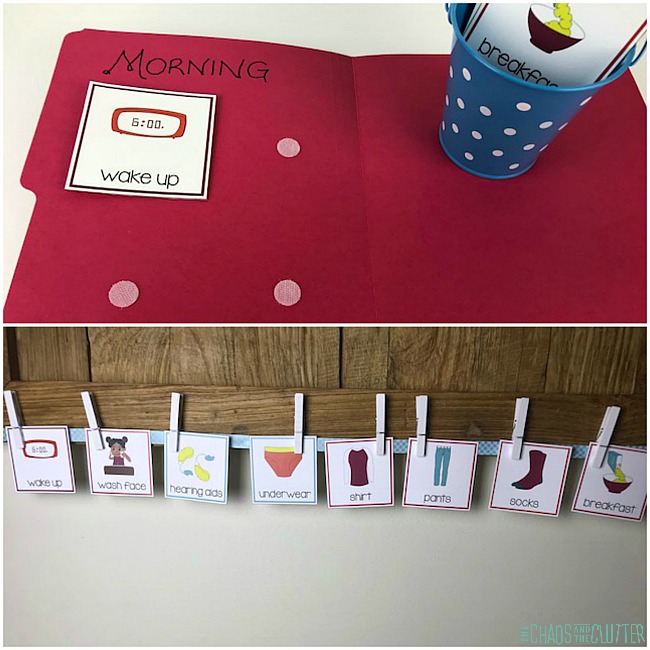
  4. Give your child a folder or binder that contains the cards needed for their morning routine. These can be glued down on a page in the binder with the heading “Morning” or you can add velcro dots to the page and to the backs of the cards and glue an envelope to the inside of the binder for easy storage of the cards.
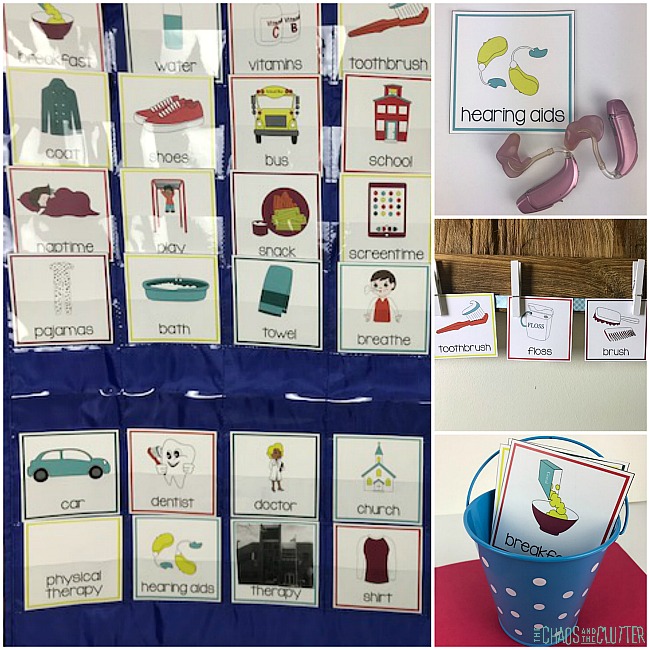
  5. Hang a ribbon or string in your child’s room. Use clothespins to attach their visual prompts in the order they need to be completed. Provide a small bucket or envelope that your child can put the cards into once they’ve finished each one. 

Create a daily schedule.

  1. Make a poster for your child that displays their daily schedule. See the method for making the poster above.
  2. Create a visual representation of your child’s day on the side of the fridge using magnets on the back of the cards.
  3. Make your child a binder separated into Morning, Afternoon and Evening to further simplify things.
  4. Another way of creating a daily schedule is by using a pocket chart. You can add the cards needed for that day at the top of the chart in the order they will happen and store the rest of the cards either at the bottom or in a separate envelope that you can staple near the bottom of the pocket chart.

For some children, the chart can be very general, including only the highlights of the day, whereas for others, you will need to break down each thing into smaller tasks.

I don’t recommend using binder rings for an entire daily schedule as it can be too overwhelming for a child.

Break down tasks.

Some of the cards break tasks down for kids to enable them to complete them step by step. These cards work well in these ways:

  1. Hole punch the cards and attach them to a binder ring. This way, the child can carry it with them. This is particularly good for the bathroom prompts. They can flip through the cards as they complete each step.
  2. Use poster putty or teacher’s tape to attach cards to the bathroom wall or mirror for the bathroom cards and the step by step instructions for hand washing.
  3. Attach the cards to the back of your child’s bedroom door or the wall in the entryway for reminders such as putting on their shoes and coat or taking their lunch. 

For school and appointments:

  1. When I created this visual schedule, I purposely left some of the cards such as those for Speech, Occupational Therapist, Therapist, etc. without an image. This was so that the child or parents could add a picture of the building or actual therapist to the card. For some children, especially those with autism, it helps to have things as concrete and specific as possible. Seeing the actual building or person they have an appointment with helps create security and aids in the transition.
  2. Children can use the pocket chart, binder, or binder ring method to use their visual schedule as their prompts while at school.

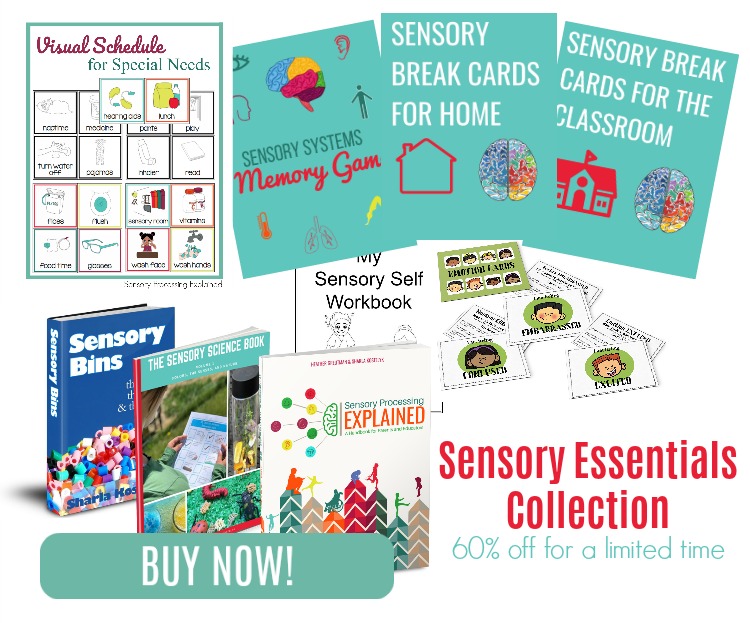
For a short time only, the Visual Schedule for Special Needs is included in the Sensory Essentials Collection which included many other resources for helping kids thrive.

Filed Under: Sensory, Special Needs Parenting

The Day Her Hair Fell Out – Reflections from the Mom of a Daughter with Alopecia

By Sharla Kostelyk

Mother’s Day is the one day of the year that I kind of expect that I’ll get to sleep in. It doesn’t always work out, but now that the kids are older, I thought that for sure this year it would happen. That morning, I woke up to the sound of “mommy”. There was a catch in her voice, that little signal that as a mom, lets you know that something is wrong.

I sat up. I knew that there would be no sleeping in this Mother’s Day or going back to sleep. My sixteen year old daughter was standing by my bed. She looked uncertain. How Parents Can Help a Child Through Alopecia #alopecia #specialneedsparenting #parentingtips“Mom, I don’t know what’s happening. I woke up and half of my top eyelashes are just gone.”

I looked at her. Sure enough, from the middle out on both sides, her eyelashes were missing. It was like they had been stolen in the night.

“Alopecia.” The word was immediately in my head. I didn’t dare say it out loud.

This was my daughter who had already overcome so many obstacles in her life, who had faced challenges before she was even born, who had battled lung disease, who had spent years in and out of the hospital, who had watched as her siblings played outside while she had to stay in, who had painful medical procedures and still goes for regular injections. How could this be happening to her?

My brain went into “it’s not fair” mode pretty quickly. I know that it’s just hair, but she’s a teenage girl and that’s hard enough without something that sets you apart. Part of me wanted to scream. I didn’t say any of these things to her.

I told her that everything would be okay. Next, I asked if she had used different mascara recently. I advised her to stop wearing makeup until we could figure out what was happening. An appointment was made with the doctor. But I knew.

Over the next few days, her eyebrows began to thin out. Within a week, she had lost the top and bottom eyelashes on both eyes. It was no surprise when the doctor confirmed what I had suspected. She had Alopecia.

He told us that in some people, they will just lose their eyelashes or eyebrows and not their head hair, so we were hopeful for that.

13 days after that Mother’s Day morning, my daughter was once again standing at my bedside. This time, tears were streaming down her face. She had woken up to a pillow covered in hair. About a third of her hair had fallen out.

She climbed into bed with us and we all cried together. I was rocking her while she cried with her head on my shoulder. When she pulled away, there was a thick patch of hair where her head had been. We all looked at it. I wasn’t sure if I should keep the hair or throw it in the garbage. At first, we started to cry harder until we burst into laughter.  There’s no protocol for this one in the parenting books!

I’m so proud of my girl. An hour after we cried in my bedroom, I dropped her off at her swim instructor practicum. Even though she was embarrassed about her lopsided, strange looking hair, she knew she had a commitment to keep.

Here’s where the hard mom stuff comes in though. Part of me wanted to tell her that it was okay to call in sick that day, to stay home, to hide away while she adjusted to the idea. I was hurting for her. I worried that she would encounter stares and harsh words. As a mom, I wanted to protect her from it.

But I knew that it would only get harder if she didn’t face it right away. I knew that I could only help build up her confidence and arm her with what to say if people asked questions. It was an obstacle I couldn’t climb for her, one that I could only help guide her through.

She is, of course beautiful with or without hair, but losing your hair and your eyelashes when you’re sixteen is just plain hard.

We went to a wig shop a few days after she started to lose her hair. The ladies there were all bald as well. It was wonderful for my daughter to be able to talk to others who understood. They were so kind to us.

In the end, she decided to hold off on getting a wig for now, but did get a special hat because we discovered that you get very cold at night when you don’t have hair on your head.

Each day, she lost more hair in clumps. Bald patches began to join each other to form larger bald patches. That Friday, we sat in my kitchen while my dear childhood friend who’s a hairdresser shaved off the small bit of hair remaining. It was emotional. Again, I know it’s just hair. I have close friends who’ve lost their hair from cancer treatments and Alopecia is not life threatening.

I have perspective and my daughter does too. She knows that there are worse things that she could have lost. After all, her youngest sister lost her hearing a few years ago.

Last year, her best friend lost her mom.

We remind ourselves about these type of things to keep our perspective. We have also allowed for the natural grieving because keeping perspective doesn’t mean that we can’t still acknowledge the hard.

But it’s still hard. There have been lots of hard moments. Her first time being around her friends without a hat. Being on a youth group outing and having to decide if she was brave enough to take her scarf off so she could waterski. Learning to apply eyeliner in a certain way so that no one can tell that she doesn’t have eyelashes. Attending a wedding. Feeling ugly. Wanting to be like the other girls her age.

I’m incredibly proud of how she has handled it. Overall, she has been optimistic and kept a sense of humour. She has been an example to me and to her siblings of courage and grace.

I asked her if she was okay with me sharing this story here on the internet for everyone to see and she agreed immediately. It understandably took her a few extra minutes to agree to having the pictures shared.

She hopes that in sharing what this journey through Alopecia has been like, I might be able to help other moms better support their kids through it.

With that in mind, my daughter asked me to share the things that I did that she found helpful. She wants other moms to know what to do if this happens to their child.

Helpful tips for parents of kids with Alopecia:

  • give your child the freedom to grieve
  • give yourself permission to grieve
  • acknowledge the loss, but offer perspective
  • help them process and express their emotions
  • help them with accessories (scarves, special hats, wigs)
  • push them out of of their comfort zone (through encouragement, not force)
  • practise with them what to say when people ask questions
  • use the lessons you learn to help others (serving helps give purpose and perspective)
  • find others they can talk to who have Alopecia (there’s a local support group near us)
  • point out others who have Alopecia and are successful (like Kevin Bull on American Ninja Warrior)
  • research the condition (knowledge is power)
  • don’t fall for quick fixes and expensive treatments that don’t work

My daughter’s hair grew back, but a few months later, her eyelashes started to fall out again. We know that it will likely be something she battles throughout her life. She had an easier time the second time because she knew that she had new coping skills for facing it again.

If you or your child are facing Alopecia, know that you are not alone. You will get through this.

Filed Under: Special Needs Parenting

  • « Go to Previous Page
  • Page 1
  • Interim pages omitted …
  • Page 4
  • Page 5
  • Page 6
  • Page 7
  • Page 8
  • Interim pages omitted …
  • Page 19
  • Go to Next Page »

Primary Sidebar

Categories

We are a participant in the Amazon Services LLC Associates Program, an affiliate advertising program designed to provide a means for us to earn fees by linking to Amazon.com and affiliated sites.

Copyright © 2026 • The Chaos and the Clutter • Site Design by Jeni @ The Blog Maven

Return to top of page

Copyright © 2026 · Chaos and the Clutter 2.0 on Genesis Framework · WordPress · Log in