• Skip to primary navigation
  • Skip to main content
  • Skip to primary sidebar
  • Home
  • About
  • Contact
  • Privacy + Terms
  • Affiliates

The Chaos and the Clutter

  • Facebook
  • Twitter
  • Pinterest
  • Google Plus
  • RSS
  • Email
  • School at Home
  • Sensory
    • Sensory Processing Disorder
    • Awesome Sensory Play Activities
      • Sensory Bins
      • Sensory Bottles
      • Sensory Bags
  • Family Games
    • Minute to Win It Games
  • Special Needs Parenting
    • Childhood Anxiety
    • Reactive Attachment Disorder
    • Sensory Processing Disorder
  • Store
  • Course Login

Sharla Kostelyk

12 Things That Special Needs Mom Needs from You

12 Ways to Support a Special Needs Mom

By Sharla Kostelyk

I am that special needs mom. It’s not something I aspired to or wished for, but it is what I am all the same. I was the friend that gave. I dropped off the casseroles, offered to babysit, organized the fundraisers, gave a shoulder or listening ear, hosted the get-togethers. Now, I’m the friend that needs.

I was more comfortable helping that I am accepting help. It hurts to feel vulnerable. It’s lonely being the mom who is always just a bit on the outside of the discussions that other moms have. And yet, I am here. I am that special needs mom.

12 Things a Special Needs Mom Needs from youI now need the village. I don’t know what I would do without my support network, those who have stood by me during the hardest years of my life. They have listened even when they haven’t understood. They have cried with me, prayed for me, and made sure that I still have the chance to laugh.

Some of them are special needs moms themselves, part of this sorority whose initiation we didn’t mean to take. Some of them are women who’ve never walked this road themselves but still chose to willingly come alongside and help carry some of the weight with me.

What That Special Needs Mom Needs From You:

Just be there.  When things get hard, people leave. She is lonely. She has already had people slowly back out of her life now that she is walking this road. Don’t be one of them.

Encourage without advice or judgment. Tell her that she’s doing a good job. Remind her that her instincts as a mom can be trusted. Support her decisions even if you don’t understand them.

Don’t ask, “have you tried xyz?” The message that can send is that there is more this mom could be doing. Believe me, she is exhausted enough already. She has tried so much already, only to be disappointed. The last thing she needs is another serving of guilt. She’s got enough of that to go around as it is.

Include her. When my special needs kids were younger and still super cute, I still got invited to the playdates and my kids got invited to the birthday parties. But as the kids got older and the differences became more apparent, the invitations grew less and less frequent.

Sometimes I’d even hear about a group of my friends (ones that I had introduced to each other) getting together without me. I still remember crying when I heard about a birthday party taking place for my friend’s little girl and my daughter, who considered that girl her best friend, hadn’t been invited.

Include that special needs mom. It might make your gathering less predictable or more stressful to have her kids there, but it’s only a few hours of stress for you. For her, it’s a few hours of feeling like she and her kids are accepted. It’s everything to her and it’s worth some measure of your discomfort.

Include her in your conversations too. It is common that when a friend becomes a special needs mom, you stop telling her your stories or stop complaining to her about things your kids do or hard things in your life because you assume that your small trials are so trivial compared to her big ones. Or maybe you think it will make her feel jealous or angry.

While I can’t speak for all special needs moms, speaking for myself, I want to be included. I haven’t forgotten what it was like to have toddlers. I haven’t forgotten how hard just regular parenting can be. Yes, I have a lot on my plate but I still want to share my friends’ burdens, to be given the chance to be there for them. Don’t protect me. Don’t think that because my problems are big, I can’t understand yours. Burden me.

Extend grace. This is a bit of a tricky one because I just finished saying that you should still treat your special needs mom friends normally and now I’m saying that you need to make exceptions for them. You do. You need to both include them and extend them grace.

They will be late. They may cancel on you often. They can’t be as dependable as they want to be.

Their life is often determined day by day or minute by minute and a medical emergency or being up all night the night before or an epic meltdown ten minutes before they were trying to get out the door mean that they can’t control things like being on time.

I used to be the one bringing the snacks shaped like ladybugs with the perfectly packed diaper bag and the kids in the coordinating outfits with their hair done beautifully (true story). Now, I’m the one arriving with a bag of tortilla chips I picked up at the convenience store on the way, asking if I can borrow a comb to fix up one of the kids’ hair, twenty minutes late, and even my own clothes don’t coordinate. 

Don’t give pat answers. Don’t say, “Everything happens for a reason.” or “God doesn’t give you more than you can handle”. I was so relieved when I discovered that it is a myth that God doesn’t give us more than we can handle because before that, I’d been feeling a bit angry about what God felt I was capable of. When we found out that our daughter had progressive hearing loss on top of all of her other special needs, hearing pat answers made me want to scream.

Pray for her. As I type this, our family is walking a particularly hard road with one of our special needs kiddos, harder than I ever imagined possible. There is a group of women who have offered to sign up for days to pray for us. Sometimes on their day, they send me a scripture verse or song to encourage me and remind me that they are lifting us up in prayer. It makes me feel like we are not alone.

I had a friend last week who stopped by with a Slurpee and a hug and then stood in my driveway and cried with me before wrapping her arms around me and praying out loud right there on the gravel.

Champion her. This is similar to encourage without advice or judgement, but this is specific to those times when she is low or when others are judging her or gossiping about her. When she is low either due to her circumstances or just the weight of everything, she needs you to build her up. Help her to be stronger. Remind her how strong she is.

I recently had a friend tell me that she thought of what I do as being similar to an athlete in the Olympics, that it took the same type of strength and determination as elite athletes. To have someone tell me they admired those qualities in me and to have someone see what I do and acknowledge it gave me what I needed to push through an extra hard week.

You don’t know when your words could be the difference for someone. When you see that she is down, send her a card or a text or pick up the phone. She needs you to build her up so that she has more to give to her child. And if you ever hear anyone judging that special needs mom behind her back, kindly remind the one speaking that she has not walked in that mom’s shoes and that you think that mom is amazing.

12 Ways to Support a Special Needs MomGet to know her child. Take the time to get to know her kids as individuals and celebrate their small successes. Talk more about their personalities than their limitations.

Help. Don’t ask, “what can I do?”. See a need and meet it. Say “I love doing laundry. Would Wednesday or Thursday be better for me to come over and do some laundry for you?”

It is hard to accept help. It’s hard for that special needs mom to admit that she needs help. Sometimes when someone asks me how they can help, I’m too overwhelmed to even know what to ask for. That’s why if someone tells me something specific they would like to do, I am better able to accept it.

Create fun. Bring over a comedy. Tell her funny stories. Text her jokes. Life as a special needs mom has too much seriousness. I miss laughing until my sides hurt.

It’s during those rare moments when I’m having fun that I feel like a normal human again. I love it when a friend plans an outing or brings over a board game to play in the evening after the kids go to bed. It’s in those moments when I can forget about all the heaviness for just a short time. It feels so good to be able to stop thinking about the hard things for even a short time.

Support her marriage. Divorce rates are higher among families of special needs children. It’s a statistic that likely scares that mom. Offer to have her kids over during supper while she and her husband go out to eat. Encourage their relationship. Have them over as a couple.

It’s ok to not say anything. Don’t bring up the worst case scenario or tell the story of your cousin’s friend’s neighbour whose child had the same type of special need and something terrible happened.

If you feel the need to say something, “I don’t know what to say” or “I’m sorry” or “I’m here” will suffice.

Join me for a free 5 part email series, Little Hearts, Big Worries offering resources and hope to parents. 

I am pleased to have joined a fabulous group of bloggers to bring you this series on Parenting Special Needs Children. Be sure to read their stories this month on support.

Supporting Yourself and Your Child with Special Needs | Natural Beach Living

Am I Going Crazy? | Every Star is Different

Tips For Supporting A Child With Trauma History | STEAM Powered Family

Special needs parents: we all need support (even you) | My Home Truths

12 Things That Special Needs Mom Needs from You | The Chaos and The Clutter

Simple Ways You Can Support Special Needs Parents | B-Inspired Mama

Classroom Supports & Accommodations for Kids with Hyperlexia | And Next Comes L

A Letter to Parents with a Child on the Spectrum | Carrots Are Orange

Supporting a Family with High Medical Needs  | Grace and Green Pastures

Filed Under: Special Needs Parenting

A Day in the Life of a Special Needs Mom

A typical day in the life of one special needs mom, well as typical as any day can be.

By Sharla Kostelyk

Welcome to a peek into what the day in the life of a special needs mom looks like. Of course, a day in the life of any one mom is going to look very different than a day in the life of another mom and no two days are the same for any mom. In my case, I have five kids with special needs with a fairly wide range of different diagnoses so detailing our routine presents challenges as there are so many variables.

I decided that instead of focusing on one particular special need and explaining how that affects our family’s routine, I would instead present a peek into a typical day in the life of this special needs momma.

A typical day in the life of one special needs mom, well as typical as any day can be.It’s ironic that I’m typing this particular post today because this day is about as far from typical as you can get. I’m typing in the front passenger seat while we drive back from a camping trip with the kids. I’m not a camper, so that’s pretty outside the norm. I won’t talk about what this week has been like but instead focus what our regular days at home are like.

In our home, we have three type of days. We have what I would call at-home days and then we have appointment days and then we have never-a-dull-moment days.

At-home Days.

Before I was the a special needs mom, I was the mom of two neurotypical children so I have a pretty good idea of what the differences are between that life and the one I’m living now. A normal day now consists of me getting up before the kids are awake, working on my blog or whatever book I’m writing at the time and maybe doing a bit of tidying up and throwing a load of laundry in before the kids get up. With a large family, there is always laundry to be done!

Once the kids are up, we have our morning routine which is similar to what probably goes on in most homes but the main difference would be that particularly with our one daughter, I have to be involved and help her through her routine even though she’s ten years old, as even the basics such as personal hygiene and toiling are challenges for her due to her delays.

It’s about this time of the day that the battle of the hearing aids begins. Dancing Queen has progressive hearing loss but she is quite resistant to wearing her hearing aids. As a result, her speech continues to get worse and she becomes harder to understand so I’m quite rigid on insisting that she wear them. This battle continues off and on until bedtime and usually includes a family wide game of searching-for-the-missing-hearing-aids because she takes them off throughout the day and forgets where she puts them.

The kids have breakfast and I read them a story and we talk for a bit and pray together for people we know using our prayer wall. During the school year, one of our sons heads off to school on the bus while the rest of the kids start homeschooling.

In the midst of the morning routine and homeschooling, there are usually several behaviour issues that go far beyond what would be considered typical so we parent a bit differently than a typical family might.

Five of our kids have Sensory Processing Disorder so we take sensory breaks throughout the day and even while we are homeschooling. We also have many sensory items that we use throughout the day to make it easier for our kids to cope and even thrive.

After homeschooling, we have lunch and I do some clean-up. The afternoon is usually spent with the kids playing. This looks similar to most other kids other than the level of supervision that is needed considering their ages and the sensory needs.

Our one son comes home from school. There are some behaviour issues and sibling conflict that need to be dealt with. We eat supper. The kids play again and then we start their bedtime routine and tuck them in and I work again on my blog or writing in the evenings other than date night.

Our at-home days don’t look much different than yours might other than having to remember some of the kids’ medication schedules, increasing supervision and assistance, meeting their sensory needs, the frequency and intensity of the behaviour issues, and the worry.

I find that the worry I have as a mom of kids with special needs is a constant struggle. What that daily routine could have said was “wake up, worry, get frustrated with myself for worrying because it does no good, work, worry, breakfast, worry, homeschool, worry, pray and try to give control to God, behaviour issue, pull control back from God and start worrying again, lunch, clean-up, worry, kids playing, child gets hurt, worry, pray, supper, worry, remind self not to worry, worry some more…”

Appointment days.

I try to schedule all of our appointments in the city for one day a week instead of going to appointments almost every day. Our appointments include:

  • Miss Optimism needs two injections every second week and those are in a neighbouring city downtown.
  • Miss Optimism and Granola Girl to the paediatric pulmonary specialist bi-weekly or monthly.
  • Dancing Queen’s audiology – ear mould fittings every six months and going to pick up the new ear moulds, audiograms every six months, appointments for broken equipment which has been happening a lot lately
  • Dancing Queen to her specialists including ENT, genetic counsellor, paediatrician, psychiatrist, therapist
  • Einstein to therapy
  • Snuggle Puppy to psychiatrist, therapy, orthodontist
  • Regular appointments such as dentist, optometrist and doctor.

I also try to run my errands like going to the pharmacy plus the normal ones that other moms have to do like the bank and the grocery store on those appointment days. The grocery store is more of a challenge. Dancing Queen is too big to go in the cart or a stroller but has a tendency to wander off and has issues surrounding appropriate boundaries with strangers so a trip to the warehouse store can become a crisis or at least cause for panic in a hurry. I try to stick to going to one local store where they know us and know her and I feel much safer there. If she were to try to leave that store with someone who wasn’t me, there are many employees there who would know and try to alert me.

On appointments days (at least one a week), I need to plan for waiting rooms, lunch and snacks for the kids and those are days when I am particularly glad to have freezer meals so that I don’t have to worry about supper when we get home.

With our kids’ special needs, there is also a lot of paperwork. There are papers to apply for funding to help cover some of the costs, papers to fill out for respite, for community aid workers (don’t have that yet because I’m not done the paperwork), for their specialists, for their post-adoption workers, for the testing that needs to be done. There is literally paperwork for some of the other paperwork!

Never-a-dull-moment days.

The thing that I find most difficult about this is that I live everyday with the knowledge that any day could turn into one of these days. It’s like I can never fully exhale, never relax, and always have to be on guard. Even if I’m out on a date with my husband, the phone could ring. Even if the kids and I are having a nice relaxing day where everything is seeming to go well, things could turn at any moment.

There are two reasons that days can turn into a never-a-dull-moment day at our home. One is that two of our children have difficulty understanding cause and effect. This means that one of them may decided to jump off the back of a moving snowmobile not thinking about the possibility that her leg would get wrapped around the tread and break or one might jump from the playhouse roof over the trampoline net and onto the trampoline when her sister is already on the trampoline, thus landing on her sister’s head and causing a concussion. (both of those are our true stories and I could give many more examples) Both of our kids with this as part of their reality are improving.

When they were younger, they would run out into traffic or climb out onto the roof or find matches and light a teddy bear on fire or walk out into a field of cows at two or ride their bike through a glass panel on the deck. They still require more supervision and teaching than other kids their age might, but they are making significant progress. We now have less trips to the emergency room than we used to.

The other reason for never-a-dull-moment days is that two of our children have RAD (Reactive Attachment Disorder) in addition to PTSD, ODD and other diagnoses, so when there is a trauma trigger for one of them (which can come from anywhere at anytime), things turn very quickly. So in our house on the never-a-dull-moment days, the result may be a trip to the hospital or worse. Also with two of our girls having severe asthma, that can also result in a trip to the emergency room. So there’s always the possibility of excitement around here.

As I used to ask my friends…”please pray for boring for me!” With the risk of the never-a-dull-moment type of day always looming, that leads to more worry.

I worry about their futures. I worry about their interaction with friends or lack thereof. I worry about how others will treat them, about how they will adapt to the world, whether we are making the right decisions for them. I worry about worrying too much because I know that I am supposed to be trusting God and that fear is not from Him which brings me back to the worry-pray cycle I was describing before. I also worry about all the things that every parent worries about.

Other than our never-a-dull-moment days and the amount of appointments and paperwork I’m describing, I have the life of most any typical mom except that everything in our life is taken to an extreme both because of the size of our family and because of the special needs of our kids. A lot of the behaviours and difficulties that our kids display are ones that typical kids also display. The difference is the frequency and intensity.

Frequency and intensity pretty much sums up the life of this special needs momma. Oh and worry of course, but I’m working on that one!

Join me for a free 5 part email series, Little Hearts, Big Worries offering resources and hope for parents.

I am pleased to have joined a fabulous group of bloggers to bring you this series on Parenting Special Needs Children. Be sure to read their stories on daily life.

How to Homeschool your Child with Special Needs | Natural Beach Living

Day to Day Life Parenting a Child with Reactive Attachment Disorder | Every Star is Different

Life with Trauma ~ Living in the shadows‎ | STEAM Powered Family

Why Special Needs Moms are Exhausted All the Time, But Will Never Ask for Help| Life Over C’s

A Day in the Life: A Blogging Mom and Her Special Needs Kids | B-Inspired Mama

Everyday Accommodations & Strategies for Kids with Hyperlexia | And Next Comes L

The Importance of Visual Schedules for Non-Verbal Autistic Children | Kori at Home

Recognizing the Signs of Reactive Attachment DisorderRecognizing the Signs of Reactive Attachment Disorder

Does my Child Have Sensory Processing Disorder? If you are wondering whether or not your child has Sensory Processing Disorder, this list of information and resources will be a starting place for you to find help.Does my Child have Sensory Processing Disorder?

Filed Under: Special Needs Parenting

Breakfast in the Slow Cooker

Breakfast in the Slow Cooker

By Sharla Kostelyk

As the mom of a large family, I love my crock pot! It saves me time on busy days. Another thing that I like about the slow cooker is that it frees up space in my oven. This is particularly true of making breakfast in the slow cooker.

Breakfast in the Slow Cooker recipes including oatmeals, french toast, casseroles, quiches, and more.On a day when we are hosting a large gathering of people for brunch or celebrating Mother’s Day with a special breakfast, cooking one recipe in the crock pot frees up the oven and stovetop for me to cook other recipes at the same time.



Slow Cooker Breakfast Casseroles:

Cheesy Slow Cooker Hash Brown Casserole from here on The Chaos and The Clutter

Smoked Sausage and Hash Brown Casserole from Lauren’s Latest (pictured)

Crock Pot Breakfast Casserole from The Typical Mom

Slow Cooker Overnight Breakfast Casserole from Crazy Adventures in Parenting

Bacon, Egg and Hash Brown Casserole from Sabrina and Company (pictured)

Sausage Egg Casserole from Recipes That Crock

Slow Cooker French Toast:

Cinnamon Roll Crock Pot French Toast from Mess for Less

Slow Cooker French Toast from Growing up Gabel

Crock Pot French Toast Casserole from Moms with Crock Pots

Chocolate Chip French Toast from Or So She Says (pictured)

Banana Blueberry French Toast from Fit Slow Cooker Queen

Breakfasts in the Slow Cooker square

Slow Cooker Oatmeal:

Overnight Crock Pot Steel Cut Oatmeal from Mom Endeavors

Slow Cooker Apple Cinnamon Oatmeal from Raising Lifelong Learners

Gingerbread Oatmeal from Coffee Cups and Crayons (pictured)

Oatmeal Peanut Butter Parfait from The Sassy Slow Cooker

Slow Cooker Pancakes:

Easy Slow Cooker Pancakes from The Sassy Slow Cooker

Blueberry Vanilla Pancakes from Slow Cooker Gourmet

Cinnamon Swirl Pancake Bake from Homemaking Hacks

Slow Cooker Eggs:

Crock Pot Hard Boiled Eggs from Laura’s Little House Tips

Crock Pot Healthy Sausage Mediterranean Quiche from The Cookie Rookie

Slow Cooker Veggie Omelette from Diethood (pictured)

Spinach and Feta Quiche from Simply Stacie

Frittata with Broccoli, Ham and Swiss from Kalyn’s Kitchen

Other Slow Cooker Breakfast Ideas:

Crock Pot Orange Sweet Rolls from Kevin & Amanda

Sausage, Gravy and Biscuits from The Sassy Slow Cooker

Breakfast in the Slow CookerI hope you enjoy these breakfast in the slow cooker recipes. You may also be interested in some of our other crock pot recipe collections:

Summer in the Slow Cooker squareSummer in the Slow Cooker

Filed Under: Cooking in the Chaos

Must Haves for Kids with Sensory Needs

These are must-haves if you have kids with sensory processing disorder (SPD).

By Sharla Kostelyk

Four of my kids have Sensory Processing Disorder (SPD). It’s been a challenge to learn what works best for them but now that we have been on this road for many years, I have discovered things that make their lives so much easier.

I wish I had known in the beginning what a huge difference a few small changes could make. These are some of the must-haves that I have found in working with them. It was hard to create this list because not only are there different types of Sensory Processing Disorder that present very differently and can actually present opposing needs, but each child is also so unique.

You can read more about the signs of Sensory Processing Disorder here. I am sharing what works for some of my kids. What works for other kids with sensory needs may vary.

These are must-haves if you have kids with sensory processing disorder (SPD).

The books…

For parents and teachers, the best book out there is Sensory Processing Explained. I may be slightly biased since I am one of the authors, but it is such a wealth of information. The information is accessible and easy to understand.

There are several books geared towards children regarding Sensory Processing Disorder and I have shared some in Must Have Sensory Processing Books for Kids.

You can also find all of my favourite books for parents on Sensory Processing in The Best Books on Sensory Processing for Parents.

Weighted items…

Not all of our kids like weighted items but the ones that do, love them! We buy our weighted blankets, capes, neck rolls, and neck curves at Innovaid (you may recognize some of the models on their site as my kids!).

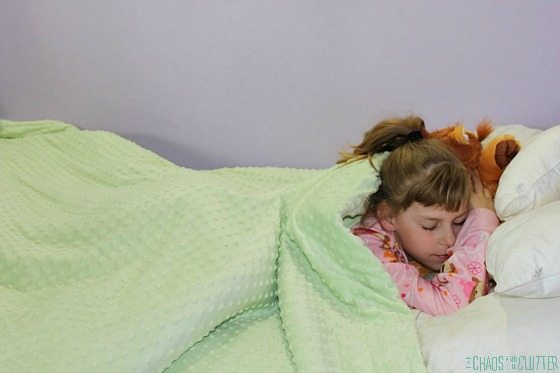
Two of our kids who like deep pressure have a very hard time sleeping without their weighted blankets. Those same two have an easier time attending during our homeschool lessons if they wear a weighted cape or neck curve. They also have weighted stuffed animals that seem to help calm them.

There are tutorials available that walk you through making your own weighted blanket. (hint: click that highlighted text to take you to a list of online tutorials) There are also tutorials for making your own weighted vests.

weighted blanket for sleep

Fidgets…

Fidget toys such as the ones from Tangle Creations can be very helpful in focusing. Especially for children who have to attend for longer periods of time, they can make a tremendous difference. In order for something to be called a fidget toy, it doesn’t need to be officially sold as such. The one most often used by my kids is sensory balls and we make our own for pennies.

Create Your Own Sensory Balls (for pennies each)

My kids also use things like knobby balls or stretchy snakes when they are sitting at their desks so that they have something in their hands to squeeze and pull and move around in their fingers but that doesn’t make a lot of noise or distract the other kids.

Seat Aids…

Two of my kids really like the Movin’ Sit Cushion. This wonderful invention allows them to stay seated but move around silently at the same time! Not all of my SPD kids like it though.

movin' sit cushionThere are other ways to help your child with SPD in sitting. At places like Ikea, you can buy round textured disks that are about the size of a seat and some kids like the feel of sitting on them.

Another adjustment you can easily make to the chairs in your home to make them more SPD-friendly is to put a theraband or other type of stretchy band around the legs of the chair. This provides sensory feedback to a child who is sitting swinging their legs, as the backs of their legs will make contact with the theraband.

One way to explain why some children find this helpful is this…children with SPD do not always have a good sense of where their own body is in space and when their legs swing freely while they sit, it can be an unsettling feeling, but providing a resistance band on the legs of the chair gives them feedback and lets them know where they are in relation to the chair and to the room around them.

Other suggestions include things such as bean bag chairs or swivel chairs, though I don’t recommend swivel chairs in a classroom setting! We have a bean bag chair in our homeschool classroom and it is very popular!

Sensory Bins…

We use sensory bins every day in our home and our homeschool. All of our kids love them and they have been particularly effective with our kids who have SPD. I try to make a different sensory bin every week. I sometimes incorporate what we are learning in our homeschooling into the sensory bin.

The Ultimate Guide to Sensory BinsChew Toys…

Some sensory kids feel the need to chew on things. If they are not given something to chew on, they will chew on pencils, clothes, toys, or even their own fingers. For “chewers”, chew toys are a healthy alternative to those things. There are chew toys that can be purchased, Chewlery (chewable jewelry), pencil toppers designed to be chewed on, or chewy wrist bands.

Play Dough…

Play dough is an inexpensive and effective tool to use with kids with SPD. If you have some readily available, kids can use it when they are anxious, overstimulated or even while they are trying to sit still and pay attention. The store-bought play dough doesn’t stay soft for very long and can get crumbly and messy, so I prefer to make my own such as this lavender scented playdough (although I don’t love all that stirring!). There are many wonderful recipes available for homemade playdough online like Jello Playdough and I have included some recipes in my Sensory Bins book.

Anxiety Aids…

Sometimes, sensory issues and anxiety can go hand-in-hand. For my youngest daughter who deals with anxiety due to other issues, I have created an anti-anxiety kit and many of the items in the kit are useful with all of my kids, particularly when they are overstimulated and are having a hard time self-regulating.

Create an Anti-Anxiety Kit for Your ChildSnugness… 

Some of my kids are more comfortable wearing tight clothing or having the feeling of being snug. There are several ways that we achieve this. One is by them wearing a gymnastics body suit (the kind that goes down almost to the knee) that is a size or two too small underneath their clothing. Innovaid carries a pressure vest that provides essentially the same effect and can be worn under or over clothing.

pressure vest

Another way is by using a sensory sock. You can make your own by sewing a tube with stretchy fabric.

Music…

Some children with SPD find music soothing and it can help with their self-regulation. For kids who prefer white noise, a small sound therapy machine can be invaluable. When it comes time to do quiet seat work in our homeschool, ironically, the classroom is actually quieter if I play music while the kids do their work!

Noise Reduction Headphones:

One of our sons could not get by without his noise reduction headphones. He is extremely sensitive to sound and uses them in the house and especially when we go somewhere that is going to be loud. I try to remember to bring them with us when we will be going to see fireworks or in a crowded place that may be noisy. They have made a huge difference.

Looking for more help? Sign up for a free 5 part email series, Little Hearts, Big Worries offering resources and hope for parents.

What items have you found to be must-haves with your kids with sensory needs?

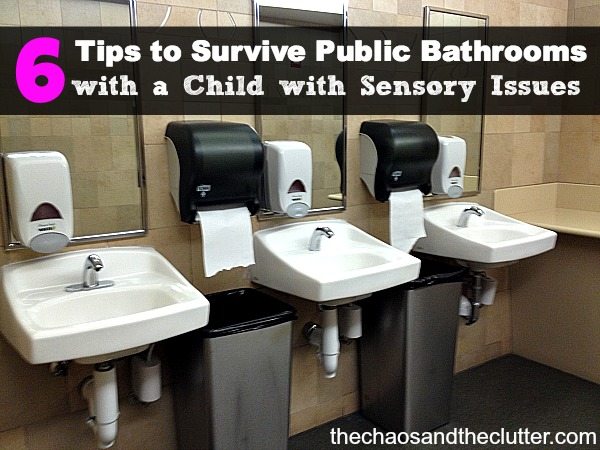
6 Tips to Surviving Public Bathrooms with a Child with Sensory IssuesSurviving Public Bathrooms with a Child with Sensory Issues

Filed Under: Sensory, Special Needs Parenting

Squishy Shark Sensory Bag

By Sharla Kostelyk

The Ocean Sensory Bottle I made last month was one of the kids’ all-time favourites so I decided to make a sensory bag to go along with it. They loved our squishy Shark Sensory Bag.

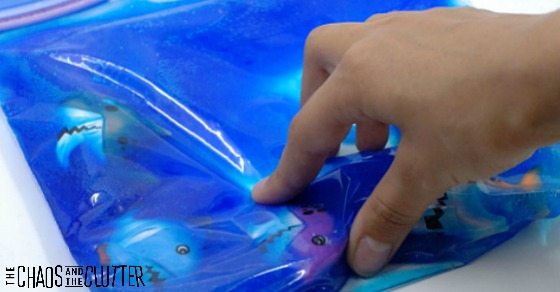
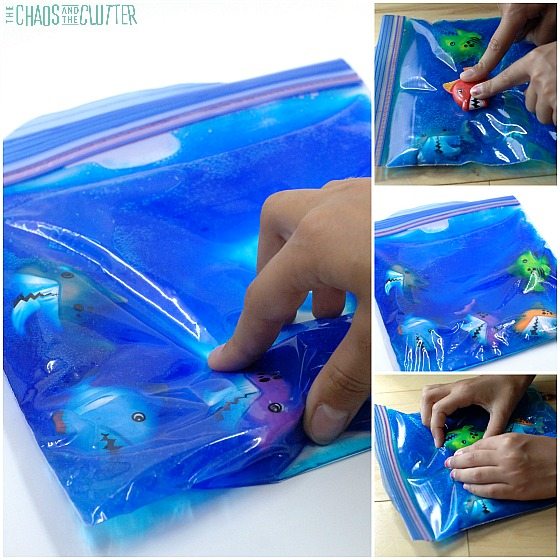
Squishy Shark Sensory Bag - a fun sensory activity for toddlers and preschoolersTo make this shark sensory bag, I used what was left of the blue body wash we used for the Ocean Discovery Bottle and topped it up with some liquid hand soap. The liquid hand soap that I used was green so I added some blue food colouring to the bag to create a really vibrant blue. Then I just plopped some toy sharks into the bag and sealed it up.
Materials needed:

  • medium sized resealable bag (I used a freezer bag because I wanted it to be stronger)
  • blue body wash or liquid hand soap (or you can use both like I did)
  • small plastic sharks
  • optional: blue food colouring
  • optional: clear packing tape

Squeeze the body wash and/or liquid hand soap into the resealable bag. Fill it about half full. For a more vibrant blue colour, add some blue food colouring to this step and then squish it around to mix.

Shark Sensory Bag squareAdd some toy sharks to the bag. The ones I used were plastic and weighted because they are meant to be a diving toy in a pool. I bought them from the dollar store. Any small shark toys would work well.

Take out the excess air and seal the bag. If you are using this bag with little ones, I suggest that you fold a strip of packing tape over the top of the bag after sealing. This will ensure that the bag won’t get opened by little ones and that you won’t get goop on your floor!

Shark Sensory Bag FBFor toddlers, you can tape the bag onto a table to make it easier for them to move the sharks around. Of course, as with all activities, your child should be supervised while playing with their shark sensory bag.

This would a cute and easy way to create a sensory activity for Shark Week.

Ocean Sensory Bottle squareOcean Sensory Bottle

Join our free 5 part email series Sensory Solutions and Activities and get our Sensory System Behaviours Easy Reference Cards.

Filed Under: Sensory Tagged With: sensory bags, sensory play

Recognizing the Signs of Reactive Attachment Disorder

Recognizing the Signs of Reactive Attachment Disorder

By Sharla Kostelyk

Last month, I was asked to take part in a year-long blog series on Special Needs parenting. The other bloggers participating are women that I greatly admire so I eagerly agreed to take part. The theme for the first month was “recognizing signs”.

I did not expect to be writing about the signs of Reactive Attachment Disorder because it is hard for me to talk about. RAD is the one diagnosis that I probably struggle with the most, both because it is the most challenging and because it is one that I never imagined we would be living through.

In the adoption world, Reactive Attachment Disorder or RAD is the worst case scenario. It is the mental health diagnosis that you are warned about, but the one that you think could never happen to your family. Like many disorders, there is a spectrum with some children being more severely affected than others.

I remember watching a documentary in a College Psychology class about RAD and the girl in it having no conscience and trying repeatedly to murder her adoptive parents. RAD is the stuff nightmares are made of. It is considered to be the most severe form of childhood mental illness.

Recognizing the Signs of Reactive Attachment DisorderIn our years as foster parents, we did take care of a few children who had been diagnosed with RAD, but it is different to know that you are the foster parent, a temporary home for that child, that you can take care of them and meet their needs but at the end of the day, if an emergency arises or if it becomes too much for you to handle, there is a social worker you can call who can step in.

When we began our journey to international adoption, we knew that the possibility existed for our child or children to have RAD, but we still didn’t think it would happen to us.

One of the reasons that we chose to adopt from Ethiopia was because we knew that children are generally highly regarded in their society, the children were well cared for in the Orphanages (unlike the horror stories you hear of in Eastern European Orphanages) and we heard that it was unlikely for these children to have issues with attachment. We were naive. There were many risk factors still present.

Any time a child is separated from their primary caregiver, moved to an Orphanage where they are one of dozens or hundreds of children and then moved to a different Orphanage, there are likely going to be attachment issues. Add in some childhood trauma and an adoption fraught with challenges and Reactive Attachment Disorder is almost a guarantee.

When we adopted from Ethiopia, we already had two biological children and three adopted children, so we were not new to parenting or to adoption. We were well versed in secure attachments and knew that in adopting older children, we would have to be actively working on attachment. We had plans in place for helping these children transition to our family and to help them attach to us. We assumed that with enough love, enough effort and enough time, we could help them heal and attach. 

Even while still in Ethiopia with our kids, we could see that the challenges were much more than we had anticipated. It was obvious that they were terrified of us. They flinched or lashed out anytime we got near them. By the time we got back to Canada, we were all exhausted.

We settled into our new life at home with seven kids and began to work at helping them adjust. That meant teaching them English, getting medical attention for things like parasites and fungus and accessing play therapy. Over the months, they seemed to be settling a bit and we thought that we could see light at the end of the tunnel. That was not to be. More accurately, the tunnel is just much longer than we thought.

I don’t want to share specifics or much of a timeline because I am attempting to walk that line between helping others who are walking this road and protecting the privacy of my children. I will share a few personal things from our story further down, but the following lists are general symptoms and signs of Reactive Attachment Disorder. Not all signs will be present in all children with RAD.

In our two kids who are diagnosed with RAD, they each present quite differently and they each have signs that the other does not. Neither of them has all of these symptoms.

Signs of Reactive Attachment Disorder:

  • anxiety
  • trouble sleeping
  • lack of boundaries
  • hypervigilant
  • extreme dependence
  • acts much younger than chronological age
  • underdeveloped conscience, lack of remorse
  • inappropriate responses (laughing or smiling when something is sad)
  • fake, not genuine
  • academic struggles
  • difficulty showing affection
  • disobedient
  • defiant
  • argumentative
  • controlling
  • bullying
  • aversion to physical touch
  • tantrums or rages
  • sensory issues or sensory processing disorder
  • withdrawal
  • lack of eye contact
  • incessant chatter
  • not asking for help when hurt, sick or needing assistance
  • socially indiscriminate
  • manipulative (can be excellent at triangulating adults)
  • frequent lying
  • blames others for their mistakes
  • irresponsible
  • physically and verbally aggressive or abusive
  • mood swings
  • depression

Children with RAD are at higher risk for SPD, cognitive delays, malnutrition, language delays, depression, anxiety disorders, and ADHD.

Early intervention is key. Reactive Attachment Disorder does not have to be a life sentence and the chance of healthy future relationships is possible.

Our Reactive Attachment Disorder Experience:

We saw signs of RAD in our Ethiopian born kids from the beginning, but we were in denial for a long time. I believed that with enough love, we could “fix” them. One of our kids showed classic signs of “mommy shopping” from the beginning, being overly affectionate with strangers and giving her best self to those outside our family.

Our daughter was literally willing to go with anyone and still shows these boundary issues almost seven years after her adoption. She has gone into strangers’ homes, strangers’ garages and would be willing to go into a stranger’s vehicle. We always have to supervise her for this reason.

Our kids showed many other signs as well. It became obvious that our efforts towards attachment were not going as planned. Things came to a crisis point and we were finally able to get professional help for our two kids from Ethiopia who were both diagnosed with RAD, PTSD (post traumatic stress disorder) and one also diagnosed with an anxiety disorder and the other with ADHD (both things are in the list of diagnoses that children with RAD are at higher risk for).

The kids each took part with us (separately) in a year-long intensive group for kids with trauma and attachment issues. We worked in the program with a team of professionals including a psychiatrist, OT, therapists, and others to help them find some healing. We came to the agonizing decision to add medication as a piece of the therapy puzzle. Even with medication and years of therapy, the kids have significant daily challenges.

We want to help them to reach healing in their journey. On bad days, I wonder if healing is possible, but I have seen glimpses that give me reason to hope.

Hope for Reactive Attachment Disorder:

Last November, we conducted a therapy camp for five of our kids at home based on many of Karyn Purvis‘ principles and methods. For one week, we unplugged, had therapy activities and exercises scheduled every 15 minutes or so for 9 hours a day plus family connection time every other waking hour. It was intensive, exhausting, challenging, and worth every second.

We saw tremendous gains in all of our “campers” in things such as communication, problem solving, sensory issues, and self image. We also saw gains in positive attachment signs such as willingness to ask for and accept help, eye contact and giving us glimpses into who they really are.

Of everything we have tried, it has been the Karyn Purvis model that we have found the most success with. We attended her Empowered to Connect conference in 2015 in Minnesota, have bought and watched all of her 13 videos many times, read her book The Connected Child and read many of the articles she has written.

Sadly, Dr. Karyn Purvis passed away after a long battle with cancer, but her legacy in working with children from hard places lives on. You can access articles, short videos, and articles on Empowered to Connect. The videos we have found especially helpful are on the TCU website.

Join me for a free 5 email series, Little Hearts, Big Worries which will provide you with resources and hope for parenting your child.

I am pleased to have joined a fabulous group of bloggers to bring you this series on Parenting Special Needs Children. Be sure to read their stories on recognizing signs in their children.

10 Early Signs of Autism | Natural Beach Living

How to Recognize Signs of a Mood Disorder in Young Children | Every Star is Different

Recognizing the signs – Childhood Trauma  | STEAM Powered Family

Hemophilia, Juvenile Arthritis, and Allergies… Oh my | Grace and Green Pastures

Myths About Recognizing Developmental Delays | Life Over C’s

7 Sanity-Saving Tips if You Think Your Child has Special Needs | B-Inspired Mama

When They Say It’s Just Your Parenting | This Outnumbered Mama

Signs That Your Early Reader Has Hyperlexia | And Next Comes L

How to Deal with the Unexpected Learning Disability | Kori at Home

Forgiving Myself for Denying the Signs of Autism in My Daughter | Parenting Chaos

Filed Under: Adoption, Special Needs Parenting

  • « Go to Previous Page
  • Page 1
  • Interim pages omitted …
  • Page 69
  • Page 70
  • Page 71
  • Page 72
  • Page 73
  • Interim pages omitted …
  • Page 128
  • Go to Next Page »

Primary Sidebar

Categories

We are a participant in the Amazon Services LLC Associates Program, an affiliate advertising program designed to provide a means for us to earn fees by linking to Amazon.com and affiliated sites.

Copyright © 2026 • The Chaos and the Clutter • Site Design by Jeni @ The Blog Maven

Return to top of page

Copyright © 2026 · Chaos and the Clutter 2.0 on Genesis Framework · WordPress · Log in